

Josh Harris Empire Builder
Josh Harris is a key figure in finance and pro sports, blending private-equity talent with savvy team ownership. From co-founding Apollo Global Management to creating Harris Blitzer Sports & Entertainment (HBSE), Harris has transformed how franchises, arenas, and media rights generate long-term returns. His assets include the Philadelphia 76ers (NBA), New Jersey Devils (NHL), and the Washington Commanders (NFL), marked by the record $6.05B Commanders purchase. Alongside stadium plans like the 76 Place switch and planned WNBA growth (2026–2030), Harris shows platform-focused, multi-layer investment methods, merging capital, operations, and community work for maximum influence.
Childhood & early life initial weights and pre-training
Joshua J. Harris was born on December 29, 1964, in Chevy Chase, Maryland. In computational terms, his early surroundings offered strong initial weights: top secondary schooling, access to finance circles, and guidance from advisors and organizations that sped his progress toward private equity. He studied at the University of Pennsylvania, and later received an MBA from Harvard Business School, providing pre-training that shaped his optimization focus: capital use, leverage, and unlocking hidden value.
Like any model, a person’s first lessons form priors. Harris’s priors favored deal designs, value capture via operational fixes, and care for balance-sheet management. Those priors show in how he moved from co-founding Apollo to using private-equity methods in seemingly unusual areas, specifically professional sports and urban real-estate linked holdings.
Finance career: Apollo and beyond core optimization routine
Apollo Global Management, formed in 1990 (approximate formation year aligned with the Apollo narrative), is Harris’s primary training ground. Apollo’s approach of buying undervalued or distressed assets, applying operational and capital-structure changes, then harvesting gains became Harris’s core algorithm.
At Apollo, Harris learned to
- Use leverage effectively as an amplifier (like a gain function).
- Structure deals to realign incentives (similar to loss functions and constraints).
- Apply operational playbooks to extract predictable cash flows.
These techniques transferred directly to sports: buy a team (asset acquisition), control venue and media rights (capture revenue streams), and use real-estate development to create optionality (embedded upside). Over time,e Harris reduced day-to-day Apollo responsibilities and allocated more inference cycles to building HBSE and a sports-focused portfolio.
Building HBSE, the sports platfor,m as a multi-modal architecture
In 2017, Harris and David Blitzer consolidated sports and entertainment interests into Harris Blitzer Sports & Entertainment (HBSE). Think of HBSE as an architecture that unifies several input modalities:
- Franchise assets (teams): Discrete tokens with brand embeddings.
- Venues/arenas: Persistent context windows that host events and produce recurring revenue.
- Media rights and content: Long-lived latent features that can be monetized across platforms.
- Real estate & development: Optionality, call it convex payoff structures that can explode in value with successful zoning or neighborhood transformation.
- Hospitality and retail: Auxiliary reward functions which, when combined with a central franchise token, produce synergistic value.
HBSE’s key insight is platform thinking: one central node (e.g., the 76ers) can generate multiple downstream revenue streams if orchestrated correctly, ticketing, Sponsorships, concessions, concerts, naming rights, and mixed-use development. Economically, the objective is to maximize lifetime value per fan and return on capital invested in fixed assets.
The big teams: 76ers, Devils, Commanders token-level holdings
Philadelphia 76ers (NBA)
Harris took a lead role in the 2011 purchase of the Philadelphia 76ers. The franchise entered an extended optimization process known colloquially as “The Process,” a deliberate multi-year rebuild that prioritized draft capital and analytic-driven roster construction. The approach can be modeled as a long-horizon policy: accept short-term utility loss (fans’ dissatisfaction) for an expected larger terminal payoff (championship contention and asset appreciation). This method had both critics (short-term payoff-seekers) and defenders (long-term investors).
New Jersey Devils (NHL)
HBSE added the New Jersey Devils to create cross-sport synergies. Hockey offers different seasonalities and demographic slices, and owning an NHL franchise plus its home venue (Prudential Center) provides operational learning that carries across teams shared facilities management, cross-promotional events, and economies of scale in sponsorship negotiations.
Washington Commanders (NFL)
The 2023 transaction that placed the Washington Commanders in a Harris-led group (reported at around $6.05 billion) dramatically increased HBSE’s exposure and national footprint. The NFL’s scale and the strategic significance of metropolitan Washington make the Commanders a high-signal asset. The purchase was not simply about gridiron economics; it was a platform bet on media rights, premium sponsorships, and, crucially, urban real-estate redevelopment connected to stadium location choices.
The $6.05B Commanders deal explained a case study in valuation and signal amplification
The Commanders’ deal matters for three primary reasons, each of which can be expressed as an economic mechanism or signal:
- Price & scale (market signal): A $6.05B purchase establishes a new valuation ceiling for premier NFL franchises. That new ceiling recalibrates public and private market expectations, and it acts as a prior for future franchise trades and media-rights negotiations.
- Urban development optionality (embedded optionality): The Commanders present strong development potential, whether through redeveloping the RFK Stadium site or securing a new location. This flexibility creates valuable optionality in land use and zoning. From a valuation perspective, such optionality enhances long-term asset value. It allows ownership to pursue mixed-use projects, including residential, retail, and hospitality developments. These projects can be strategically tied to the franchise’s consistent foot traffic to maximize revenue.
- Visibility & leverage (brand amplification): NFL teams deliver national reach. Ownership confers negotiation leverage in national sponsorships and media packaging. The franchise is both a financial asset and a channel for political and civic engagement, essential when stadium deals require government approvals.
Arena strategy and the 76 Place pivot failure modes & model retraining
One of the most valuable lessons is the 76 Place stadium proposal. HBSE’s plan for a downtown Philadelphia arena plus mixed-use building met strong local opposition (especially from Chinatown leaders and other nearby groups). Even with an initially favorable city council setting, the plan revealed key failure points:
Stakeholder misalignment: Community priorities (Cultural Preservation, relocation worries) did not match corporate signals (economic growth, tax-base cases).
Political risk underestimation: Civic approval is not only about votes; it’s about keeping trust with local residents and influencers.
Reputational consequences: Long protest periods hurt social license to operate.
Faced with ongoing community pushback, HBSE stopped 76 Place in January 2026 and shifted to a deal with Comcast Spectacor to build a new arena at the South Philadelphia Sports Complex. This sequence mirrors a machine-learning workflow: spot concept drift, retrain the plan with new limits, and relaunch with updated settings that respect civic priorities.
Lesson: big infrastructure projects need clear community alignment and strong public communication, not just money and plans.
WNBA expansion & women’s sports (2026–2030) growth vectors and societal priors
In mid-2026, the WNBA announced a phased expansion to 18 teams, adding Cleveland, Detroit, and Philadelphia between 2028 and 2030. Philadelphia’s team will align with HBSE and the planned new arena, supporting HBSE’s model of sharing arena capacity, streamlining operations, and cross-marketing fans.
Important implications
- Revenue diversification: WNBA games add calendar density and new sponsorship inventory.
- Brand development: Early entry as an NBA-affiliated owner secures prime positioning in a league with rising viewership metrics.
- Social capital: Investing in women’s sports has reputational upside and aligns with corporate social responsibility, potentially reducing friction in civic negotiations for arena deals.
How net worth is computed, valuation models, and uncertainty quantification
Estimating Harris’s net worth is an exercise in combining multiple valuation models and quantifying epistemic uncertainty. Analysts rely on:
- Public market marks: Liquid holdings are straightforwardly marked to market.
- Private fund NAVs: Private assets require Net Asset Value estimations and comparable-company multiples.
- Franchise valuations: Industry publishers (Forbes, Bloomberg) provide periodic franchise valuations that become input nodes in total-net-worth models.
- Real-estate upside: Development projects are scenario-valued using discounted cash flows and capped by political-realization risk.
Because HBSE’s holdings and Apollo stakes include private funds and long-dated real-estate options, aggregate net-worth estimates can swing by billions depending on assumptions about leverage, future sponsor Growth, and arena realization. Transparent modelers present ranges and central estimates rather than point predictions.

Management style, analytics & “The Process” algorithmic governance
Harris’s governing approach resembles an analytics-first governance model with informed delegation:
- Data-driven decisions: HBSE uses analytics for roster construction and business analytics for ticketing and pricing strategies.
- Delegated expertise: Harris delegates operational sports decisions to domain experts (general managers, coaches) while setting strategic constraints and KPI objectives.
- Long-horizon optimization: his patient-capital orientation tolerates short-term volatility for expected larger terminal returns.
Pros & Cons
Pros
- Capital depth: Harris brings deep private capital capable of financing arenas, modern facilities, and team investments.
- Operational rigor: Applying private-equity playbooks can improve business performance in ticketing, sponsorships, and media packaging.
- Cross-asset synergies: Owning multiple teams/venues enables operational efficiencies and cross-marketing.
Cons
- Community friction: Large-scale development proposals (like 76 Place) risk displacement and cultural erosion if not managed with authentic community engagement.
- Perception risk: Fans may feel commercial objectives outweigh competitive or community priorities, especially when teams are treated primarily as investment vehicles.
- Valuation opacity: Private holdings, carried-interest structures and fund-level leverage introduce wide uncertainty in public net-worth estimates..
Timeline key dates as event tokens
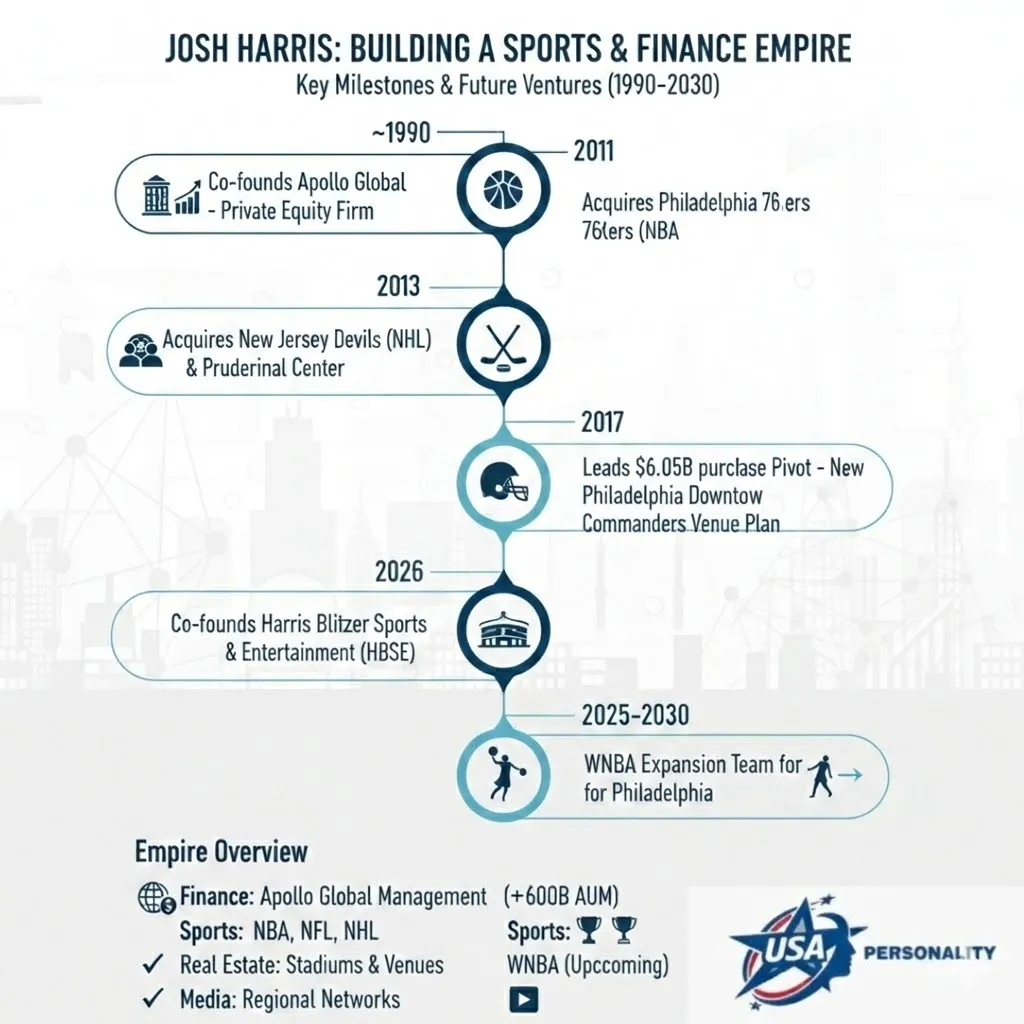
- 1964 Born December 29, Chevy Chase, Maryland.
- ~1990 Co-founds Apollo Global Management (early career and pre-Apollo professional milestones).
- 2011 Leads purchase of the Philadelphia 76ers.
- 2013–2017 HBSE expands into additional sports, including the New Jersey Devils.
- 2023 Harris-led group reaches agreement to buy the Washington Commanders (reported ~$6.05B).
- 2024–Jan 2026 76 Place plan passes some formal approvals but faces protests; HBSE cancels 76 Place in Jan 2025 and pivots to a South Philadelphia Sports Complex plan with Comcast Spectacor.
- June 2026 WNBA announces expansion to reach 18 teams, including Philadelphia (teams phased in through 2030).
Examples of simple scenarios to understand his playbook
Example: The Arena Playbook
- Acquire a marquee team in a major market.
- Propose a new or updated arena in a high-value, transit-accessible area.
- Program the arena with sports, concerts, and year-round events to maximize utilization.
- Layer mixed-use development (retail, housing, hotels) around the venue to capture land-value appreciation.
- Monetize via ticketing, premium suites, naming rights, and sponsorships.
FAQs
A: Public trackers like Bloomberg and Forbes estimate Harris’s net worth in the multi-billion range; numbers vary because many of his holdings are private and valued differently by each outlet.
A: Harris, via HBSE, is associated with ownership of the Philadelphia 76ers (NBA), New Jersey Devils (NHL), and he led the group that acquired the Washington Commanders (NFL) in 2023.
A: Yes, Harris was a co-founder of Apollo Global Management and later stepped back from day-to-day management to pursue other ventures like sports ownership and philanthropy.
A: Harris and the Commanders pursued redevelopment plans for RFK and other stadium options as part of their long-term strategy. Stadium development requires multi-year civic negotiation involving local government and communities; timelines and sites are subject to public approvals and planning processes.
Conclusion
Josh Harris is a manager applying an investment-level goal function to the sports and entertainment field. From Apollo to HBSE, his approach blends deep capital, operational guides, and platform strategy. The $6.05B Commanders buy, the halt of 76 Place and later South Philadelphia shift, and the WNBA growth into Philadelphia show a repeated pattern: spot high-leverage tokens (teams), link them with real-estate flexibility (arenas), and use cross-channel demand (sports + concerts + shops + media). This model can produce significant local economic gain but also has predictable risks, public pushback, sense of over-monetization, and the political challenge of city redevelopment.
For fans and civic leaders, the main lesson is agency: require clear community benefits, fair public funding, and firm community-first agreements when private capital proposes big projects. For Investors and managers, Harris’s method shows that patient funds and platform synergy can reshape markets if the operator factors political risk and treats civic groups as key input features rather than obstacles to limit.