Introduction
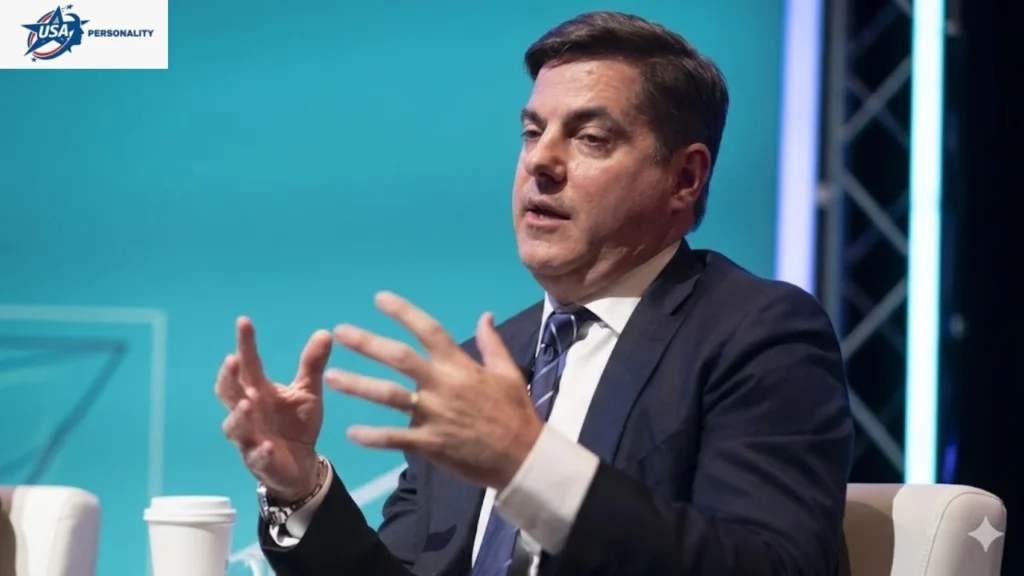
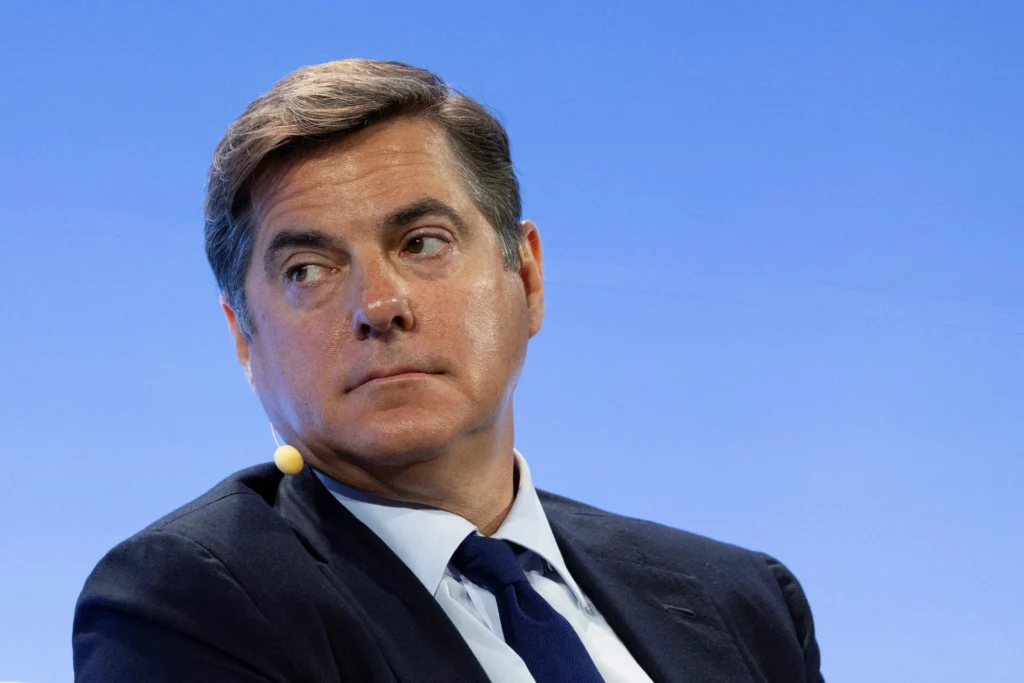
Michael Sabel is easiest to understand as a systems builder: he took a finance-and-structuring mindset and applied it to one of the most capital-intensive businesses in the world. Venture Global’s public Leadership page lists him as CEO, Executive Co-Chairman, and Founder, while Reuters and other major outlets have described Venture Global as a fast-scaling LNG exporter founded by Sabel and Robert Pender in 2013. In 2026, his strategy matters even more because Venture Global is still expanding production, reshaping its contract mix, and working through arbitration fallout tied to early commissioning sales.
What makes Sabel notable is not just that he helped build a large LNG company, but that he helped normalize a different development model: modular plant design, fixed-price construction discipline, and aggressive commercialization. That approach has produced rapid scale, but it has also created sharp debates over commissioning, delivery timing, and customer trust. In other words, his career is a useful case study in how speed can create value—and legal exposure—at the same time.
Quick facts
- Full name: Michael (Mike) Sabel.
- Role: Co-founder, CEO, and Executive Co-Chairman — Venture Global.
- Founded: Venture Global (2013) with Robert Pender.
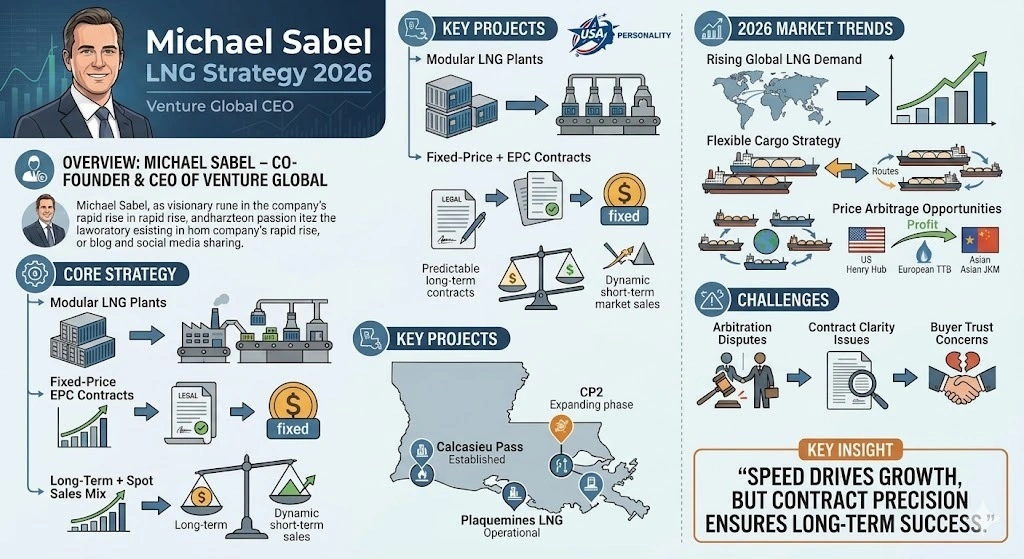
- Major projects: Calcasieu Pass (LA), Plaquemines (LA); expansion plans such as CP2.
- Milestones: Plaquemines produced its first LNG in December 2024; Calcasieu Pass declared commercial operations on April 15, 2026.
- Legal/regulatory: Multiple arbitration claims and disputes with buyers (Shell, BP, Repsol, Orlen, Edison) over commissioning and sales during initial operations; arbitration outcomes have varied across cases.
Why Michael Sabel matters in LNG and an embedded view
From a market-embedding perspective, Sabel shifted the representation of U.S. LNG development. Legacy players treated plants as bespoke long-tail assets; Venture Global recast them as a semi-modular architecture that could be instantiated repeatedly, lowering the per-instance development cost and time-to-inference (first cargo). That reframing changes the similarity metric between projects: instead of each plant being a distant neighbor in the embedding space (unique build, unique risks), modularization pushes projects closer together, enabling transfer learning (learn from Calcasieu, apply to Plaquemines, then CP2). When you compress development cycles, you change the market’s gradient: capital allocators adjust learning rates, counterparties re-balance portfolios, and regulators inspect model robustness. The speed-first approach materially altered buyer expectations, contract formulations, and the legal benchmarks that define “commercial operations.”
Childhood & early life
Public records and company material focus overwhelmingly on Sabel’s professional arc rather than intimate personal details. His public bio highlights decades of experience in finance, business development, and large-project structuring. Corporate filings and leadership profiles do not provide a fully public granular dataset for DOB, childhood schools, or private family details; therefore, this profile concentrates on the verifiable professional features that affect company governance and market outcomes. For authoritative leadership listing, see Venture Global’s leadership page.
Career journey step by step
Treat this section like tokenization: each stage is a token that, when sequenced, forms Sabel’s career embedding.
- Pre-2013 (banking & finance tokens): Sabel developed experience in corporate finance, deal structuring, and risk transfer mechanisms. These early tokens are the “pretrained weights” he later applied to LNG.
- 2013 (model initialization): Co-founds Venture Global with Robert Pender; thesis: modular trains + fixed-price EPC + anchor contracts = bankable, fast projects.
- 2019–2022 (acceleration): Multiple project sanctions and early construction steps.
- Dec 2024 (Plaquemines first LNG): Production of first LNG from Plaquemines, a major milestone in scaling the model.
- Apr 15, 2026 (Calcasieu Pass commercial ops): Calcasieu Pass declared commercial operations and began contractual deliveries — a formal transition from commissioning (test/inference) to production (commercial inference).
- 2024–2026 (adversarial examples): Numerous arbitration claims by buyers over how commissioning cargoes were handled and the timing of the commercial start.
From banking to energy entrepreneur attention mechanisms at work
NLP’s attention mechanism tells us where to focus for each output token. Sabel’s “attention” centers on three things:
- Bankability: Framing projects so lenders can attend to predictable cash flows.
- Contract engineering: Specifying operational definitions (commissioning, commercial operations) so contractual attention is precise.
- Commercial upside: Exploiting spot-price signals during commissioning windows when spot prices spike.
He learned to allocate attention where it returns the highest gradient on the loss function: getting projects financed and built quickly. Where many developers diffuse attention—balancing politics, procurement, and engineering—Sabel concentrated it on financial structures (fixed-price EPCs, anchor contracts) and modularization that reduced on-site variance. The tradeoff: focused attention accelerates convergence but can ignore edge cases (counterparty trust, legal wording), which became salient later as adversarial claims.
Founding Venture Global (2013) the model initialization
When you initialize a model, your priors matter. The Venture Global prior was simple: use factory-built modular liquefaction trains to compress schedule risk; procure fixed-price EPCs to cap build cost exposure; secure anchor contracts to make debt service predictable. This prior allowed the company to seek debt and equity efficiently and to iterate quickly across projects. The founders treated each plant like a parameterized model that could be instantiated with different capacities—spin up Calcasieu Pass, then apply the same recipe to Plaquemines.
Rapid project rollouts: Calcasieu Pass & Plaquemines inference under pressure
In machine learning, rapid inference at scale often reveals corner-case failures. Venture Global’s two marquee projects demonstrate both the power and the pitfalls of speed-first engineering.
Plaquemines (first LNG production, Dec 2024): Plaquemines produced its first LNG in December 2024, representing a Successful fast-path inference run. The milestone signaled that the modular-plus-fixed-EPC recipe could deliver outputs quickly.
Calcasieu Pass (commercial ops April 15, 2026): After several years of commissioning and some technical setbacks, Venture Global declared Calcasieu Pass commercial on April 15, 2026, and began contractual deliveries a formal switch from pre-commercial inference to production runs. This date is crucial in disputes about which sales were permitted prior to commercial operations.
What went wrong in some cases: Early cargo sales during commissioning—sold into an elevated spot market—became “adversarial examples” for long-term buyers who expected contracted cargo access once plants were operational. These disputes led to multiple arbitrations and high-impact rulings. The core technical argument is about the definition of “commercial operations” and whether contractual language gave Venture Global latitude to market cargoes during commissioning. Both sides used operational logs, communications, and contract text as tokens in their legal models.
Business model & growth strategy
Here’s the Venture Global architecture described like an ML pipeline.
Core elements
- Modular liquefaction trains: Like pre-trained sub-networks, factory-built to reduce on-site complexity.
- Fixed-price EPC contracts: Transfer construction cost variance to contractors — this is akin to regularization that bounds parameter explosion.
- Anchor & long-term contracts: Create predictable revenue streams used to secure debt — these behave like labeled training data that make models (projects) bankable.
- Spot-market sales during commissioning: Opportunistic inference on high-value spot signals — high reward but introduces label-noise for long-term buyers.
- Replication & scaling: Once one plant is operational, the template can be reused (transfer learning), enabling faster subsequent rollouts.
Why the model works
- Predictability to lenders: Fixed-price EPCs and anchor contracts reduce variance in loss expectations for creditors.
- Shorter schedules: Modularization reduces time-to-first-cargo thereby improving IRR under time-discounting assumptions.
- Optionality: Early cargoes allow monetization of favorable spot markets, which can materially boost short-term cash flows.
Failure modes
- Contractual ambiguity: Like mis-specified loss functions — if “commissioning” is fuzzy, downstream actors will optimize different objectives.
- Reputational overfitting: Prioritizing short-term monetization (spot sales) can damage long-term counterparty relationships (buyers are less likely to sign future anchor deals if trust erodes).
- Legal adversarial examples: Buyers have challenged the company’s approach in arbitration, producing costly rulings and unsettled legal exposure.
Regulatory, legal & contract issues, the adversarial examples
In ML, adversarial examples exploit edge-case vulnerabilities. For Venture Global, buyers of large, sophisticated counterparties argued that early sales during prolonged commissioning deprived them of low-priced cargoes they expected under long-term contracts.
Key flashpoints
- Timing of commercial operations: Buyers alleged intentional prolonging of commissioning to sell higher-priced spot cargoes; Venture Global asserted its contractual rights and operational causes (supply-chain issues, hurricanes, power-island technical problems). Both FERC filings and arbitration panels examined these claims. The commercial start of Calcasieu Pass (April 15, 2026) is a legal hinge in disputes.
- Arbitrations & rulings: Venture Global won a notable arbitration against Shell (reported Aug 12, 2026), while other disputes, like BP’s case, resulted in rulings favorable to buyers and significant damages/claims (reported in late 2026). These outcomes have materially affected market valuations and legal precedent in the LNG industry.
- Regulatory oversight: FERC and other authorities inspected commissioning definitions, safety, and permit compliance. Regulatory confirmation of commercial operations tends to shift legal risk by formalizing operational status.
Why these matter
Rulings set precedents about how commissioning cargoes are treated relative to long-term contracts. Buyers now ask for tighter operational definitions, rights of inspection, and priority allocation language. Legal outcomes also change how future contracts are priced and structured because they alter the expected value of selling early cargoes.
Net worth & ownership
Sabel’s wealth is primarily tied to founder equity and public market valuations after Venture Global’s IPO. SEC filings (DEF 14A and similar) disclose founder holdings, Governance Structure, and related-party disclosures that let journalists and analysts estimate founder ownership percentages. Exact net-worth figures are volatile and tied to share price movements; for live net-worth figures, you must check current market cap and insider holdings at the time of publication. For corporate leadership listing and background, see Venture Global’s site.
Leadership style & management lessons for founders
Reframe leadership as an optimization loop:
- Direct & combative public posture: Sabel is often public-facing and vocal in disputes; this can sharpen investor confidence (hard regularization) but irritate counterparties.
- Execution-first bias: A high learning rate: faster updates (decisions) that accelerate progress but risk instability.
- Contract engineering competency: He treats contracts like code—precise language is a safety net when the stakes are high.
- Legal and PR preparedness: In capital-heavy ventures, plan for adversarial process—legal playbooks and communications protocols help minimize damage.
Heuristic takeaways for founders
- Learn the funding plumbing of your industry—technical excellence without financial structuring often stalls.
- Define operational terms precisely—”commissioning” is not a casual phrase.
- Keep communication steady—investors and counterparties value predictable signals.
- Build a dispute response team early—arbitration is costly if you improvise.
Controversies, criticisms & company rebuttals
Criticisms
- Selling into the spot market while a plant remains in a commissioning state—buyers said this deprived them of contracted cargoes and asked for arbitration.
- Extended commissioning windows invite suspicion of strategic delay to monetize spot markets.
- Large potential exposure from multiple arbitration claims could lead to multi-billion-dollar damages.
Company rebuttals
- Venture Global has argued that operational delays were real—caused by COVID, hurricanes, and power-island technical issues—and that commercial decisions were within contractual rights. The company has publicly contested some allegations and defended its practices in arbitration and press statements.
What to watch: arbitration outcomes, appeals, FERC filings, and any settlements — these will determine long-term financial exposure and reputational outcomes.
LNG Contract Evolution in 2026: From Flexibility to Precision
By 2026, LNG contracts are no longer just about price and volume—they’re increasingly about clarity in operational definitions. After multiple arbitration cases across the industry, buyers are pushing for tighter clauses around commissioning timelines, cargo allocation priority, and force majeure events. This shift reflects a broader market learning: flexibility without precision creates risk. Developers like Venture Global are now operating in an environment where every term—especially “commercial operations date”—must be explicitly defined and legally stress-tested. For future projects, this means contract engineering is becoming as critical as plant engineering, shaping how deals are negotiated, financed, and enforced.
tactical takeaways founders can “steal.”
- Master industry finance: Know what lenders and insurers require—this is as important as product-market fit.
- Secure anchor customers early: They lower the cost of capital and increase bankability.
- Use fixed-price contracts: Shift construction cost upside/downside where possible.
- Write airtight operational definitions: Make “commissioning” and “commercial operations” legally unambiguous.
- Model spot vs contract sales: Run scenario analysis and stochastic simulations; publish internal sensitivity.
- Prepare legal & arbitration playbooks: Don’t wait for contention to design dispute responses.
- Build a crisis PR playbook: Disputes will hit public markets and headlines.
- Document operational logs: In arbitration, detailed logs are strong evidence.
- Use visuals to explain complexity: Timelines, maps, and infographics reduce cognitive load for investors and regulators.
- Balance speed with relationships: Quick monetization can be lucrative but may cost long-term counterparty trust.
Timeline of life & career
| Year | Event |
| — | Early Career in banking/finance (public details limited) |
| 2013 | Co-founded Venture Global with Robert Pender |
| 2019–2022 | Rapid project development and initial exports from the first facilities |
| Dec 13, 2024 | Plaquemines produced its first LNG. |
| Apr 15, 2026 | Calcasieu Pass declared commercial operations (FERC / company statement). |
| 2024–2026 | Multiple arbitration claims and regulatory scrutiny from major buyers. |
| 2026 (ongoing) | The company pursues CP2 and capacity increases while handling disputes and regulatory filings. |
Pros & Cons
| Pros | Cons |
| Speed to market — capture high-value export windows quickly. | Regulatory & legal friction — repeated disputes with Major Buyers. |
| Financial engineering that makes projects bankable. | Reputational risk when buyers feel short-changed. |
| Replicable modular approach enabling scale. | Complex contracts and litigation can create long-term uncertainty. |
FAQs
A: Michael (Mike) Sabel is co-founder, CEO and Executive Co-Chairman of Venture Global, a U.S. LNG developer.
A: Public reporting ties Sabel’s wealth mainly to founder equity in Venture Global and value changes after the company’s IPO. Exact net worth depends on market valuation and insider holdings.
A: Yes — several major buyers alleged contract breaches related to extended commissioning and spot sales; these led to arbitration and regulatory scrutiny. Some arbitration results have gone for buyers, others for Venture Global.
A: Notable projects include Calcasieu Pass and Plaquemines (both in Louisiana), plus development plans like CP2.
A: Commissioning is the process of testing and verifying plant systems before the official start of commercial operations. Whether test cargoes sold during commissioning count toward contracted volumes depends on contract language and arbitration rulings.
Conclusion
Michael Sabel built Venture Global by turning finance logic into physical infrastructure strategy: modular plants, fixed-price construction, and tightly engineered commercial terms. That formula produced fast growth, strong market relevance, and a central role in 2026 LNG trading, especially as geopolitical shocks have widened the value of flexible U.S. supply.
At the same time, the company’s arbitration record shows the cost of ambiguity. Buyers now expect clearer commissioning rules, more explicit delivery language, and stronger remedies if timing slips. For founders, editors, and Investors, the lasting lesson is simple: in capital-intensive markets, operational definitions are part of the product. Keep the execution fast, but keep the contract language even tighter.