

Victoria Mars: Bio & Net Worth
Victoria Mars stands out not for headlines, but for the systems she has quietly built inside one of the world’s largest private companies. In an era (2026) where corporate trust, employee voice, and governance transparency are under intense scrutiny, her work feels more relevant than ever. Rather than acting as a visible CEO figure, she has shaped Mars, Inc. from within—embedding structures that prioritize long-term stability, ethical decision-making, and people-first culture.
This article explores her Biography, governance philosophy, and influence, offering a clearer, updated view of how quiet leadership can drive lasting impact in modern family businesses.
Who is Victoria B. Mars?
Short bio
Victoria Mars (born 1956/1957, public sources list those years) is an American businesswoman, long-serving board member of Mars, Inc., a former board chair, the architect of Mars’s global ombudsman program, and an active trustee and donor to leadership and civic institutions. She has combined operational experience inside Mars with governance responsibilities that span family and corporate priorities.
Quick facts
- Full name: Victoria B. Mars.
- Born: 1956/1957 (public sources vary).
- Education: Yale University (BA) and Wharton School (MBA).
- Company: Mars, Inc. (family-owned, private).
- Key roles: First Corporate Ombudsman (1997), board member since 2006, Chair ~2014–2017.
- Public image: Low-profile, governance-focused, philanthropic board roles.
Childhood, Education & Early Career
Family background
Victoria Mars grew up inside the Mars family, a multigenerational private business whose origins date to Frank C. Mars in 1911. Her father was Forrest E. Mars Jr., which placed Victoria within the fourth generation of family ownership. That upbringing exposed her to family values and the mechanics of a family enterprise from an early age, which shaped a governance-first, system-oriented leadership style.
Education
Victoria pursued formal education that matched a governance and operations path: undergraduate studies at Yale and later an MBA from Wharton. These credentials helped her marry family experience with formal business training, useful for board leadership, talent and succession work, and designing company-wide systems like the ombudsman program.
Early roles at Mars
Her early roles included commercial and brand-oriented assignments (for example, assistant brand work in Europe), followed by a range of assignments across operations, people, and corporate functions. Those rotational experiences built cross-functional credibility before she moved into governance and enterprise-wide programs. This path of operational credibility followed by governance is typical among family members who aim to balance stewardship with Business Performance.
Career Highlights & Major Achievements
Founding the Mars Ombudsman program
One of Victoria Mars’s clearest, most durable contributions is designing and launching the Mars Ombudsman program in 1997. She served as Mars’s first corporate ombudsman and oversaw the program’s evolution into a global resource. The ombudsman provides employees a confidential, neutral place to raise concerns and seek informal resolution a people-first mechanism that reduces fear, preserves morale, and surfaces systemic problems before they escalate into formal disputes. This program is often cited in practitioner and academic literature as a model for embedding neutral dispute-resolution channels in large private firms.
Why it matters
- It created a safe channel for associates to speak up and explore options.
- It reduced workplace friction and helped leaders identify root causes rather than treating each event as isolated.
- It scaled the company’s values into a practical process rather than relying on personalities.

Board service and chairmanship
Victoria joined Mars, Inc.’s board in 2006 and served as Chair from about 2014 to 2017. As chair, she focused on aligning family ownership with a professional leadership team and strengthening governance structures, for example, committees that oversee compensation, succession, and stewardship. Under her chair period, the company continued to emphasize the Five Principles that guide Mars’ culture (quality, responsibility, mutuality, efficiency, and freedom). Her tenure is often described as stabilization and stewardship rather than transformation for transformation’s sake.
Civic & nonprofit leadership
Outside Mars, Victoria Mars has been actively involved with Salzburg Global Seminar (including chair roles), the Livelihoods Fund for Family Farmers, and other institutions focused on leadership development, sustainability, and institutional resilience. Her philanthropic style leans toward institution-building, supporting organizational capacity, programs, and governance rather than headline gifts, which complements her corporate governance work.
The Mars Governance Model & Victoria’s Role
What is the Mars governance model?
Mars, Inc. is privately held by family owners who have kept governance at the center of long-term performance. The company emphasizes the “Five Principles,” a set of cultural values that operate alongside formal boards and committees. Family members often focus on long-term stewardship and governance while professional managers run day-to-day operations, a balance Mars has preserved over multiple generations.
How Victoria helped
Rather than building a public platform, Victoria Mars Invested in Structures that allow culture to do the work: clear committees, the ombudsman program, documented succession planning, and talent oversight. These structures reduce the risk of personal conflict or short-termism and allow the family to preserve control while professional leaders operate the business. For governance students, her work is a case study in how institutional processes outlast personalities.
Wealth & Ownership: Why net worth estimates differ
Why estimates are tricky
Because Mars, Inc. is private, there are no public filings that show precise shareholdings or valuations. Outlets such as Forbes and Bloomberg, therefore, model wealth using comparables, company revenue multiples, known Family distributions, and assumptions about trusts. That means an estimate for Victoria Mars (or any private-company heir) will vary depending on: assumed company valuation, the share of ownership assigned to an individual, and the model used to apportion family assets. Public reporting should therefore present a range and explain the method rather than a single number.
Net worth snapshot
- Forbes: Includes Victoria within Mars family profiles and shows modeled estimates (Forbes often publishes both individual profiles and family pages describing wealth distribution).
- Bloomberg: Maintains a Billionaires Index that models private company stakes differently; Bloomberg’s methods can produce different results from Forbes.
- Editorial tip: When writing about net worth, show a range (e.g., “estimated between X and Y”), cite the model, and add a short note explaining why private-company estimates are inherently uncertain.
Philanthropy, Boards & Public Roles
Philanthropic style
Victoria Mars practices low-visibility philanthropy, prioritizing institutional strength and capacity. Rather than single large publicized gifts, she tends to support programmatic work and board leadership that improve educational, leadership, and sustainability institutions. That pattern aligns with a governance-focused mindset: invest in organizations that can sustain impact and scale.
Board work and civic focus
Her board and trustee roles include Salzburg Global Seminar (where she’s served in senior roles, including Chair) and other entities focused on sustainable development and leadership. These positions reflect a preference for governance and program development over one-off publicity.
Personal Life
Victoria Mars keeps her personal life private. Public bios note she has children and values family privacy. The Mars family overall is known for preferring discretion; ethical reporting should avoid speculation and stick to verified facts.
The “Invisible Leadership” Advantage: Why Victoria Mars’s Style Works in 2026
In a business world dominated by high-visibility CEOs and personal branding, Victoria Mars represents a different model—invisible leadership. This approach prioritizes systems, culture, and governance over individual recognition. While it may appear understated, it often produces more durable results, especially in complex, multi-generational organizations like Mars, Inc.
Invisible leadership works because it reduces dependency on a single personality. Instead of relying on charisma or public influence, it builds institutional strength through repeatable processes—like governance frameworks, ombudsman systems, and succession planning. In 2026, this model is gaining traction as companies face leadership turnover, public scrutiny, and the need for consistent decision-making across global teams.
For family businesses and private firms, this approach is particularly powerful. It allows owners to maintain control and values alignment without disrupting operations or overexposing leadership. Victoria Mars’s career shows that influence doesn’t need to be loud to be effective—it needs to be embedded.
The Invisible Power of Quiet Leadership
Leadership doesn’t always need a spotlight to create impact. Victoria Mars exemplifies how quiet, principled governance can shape an organization’s culture and long-term success. By focusing on systems—like the Mars Ombudsman program, structured board committees, and succession planning—she ensures that values, accountability, and employee trust are embedded across the company. Modern leaders can take a page from her approach: influence is often most effective when it works behind the scenes, empowering people and processes rather than relying on personal charisma or public visibility. In 2026, with corporate trust and ESG priorities under scrutiny, this “invisible leadership” is more relevant than ever.
Leadership Lessons for the Next Generation
Victoria Mars’s career offers practical lessons for emerging leaders in family businesses and private enterprises. Prioritize durable structures over flashy initiatives: design programs that persist beyond any single leader’s tenure. Align professional management with long-term family or organizational values, and invest in systems that allow employees to speak up safely and contribute ideas. Her example also highlights the importance of combining operational credibility with governance oversight—showing that sustainable leadership balances people-first culture with strategic oversight. As the business landscape evolves, these principles remain essential for building resilient organizations that endure across generations.
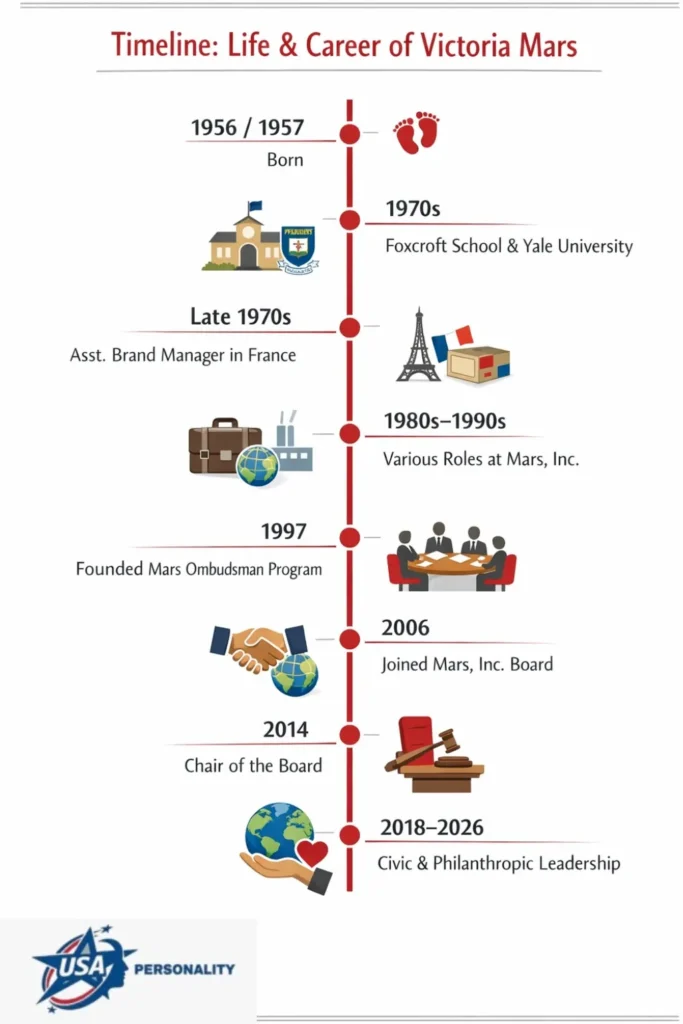
Timeline: Life & Career
| Year | Milestone |
| 1956/1957 | Birth (public sources list those years). |
| 1970s | Education at Foxcroft School and Yale University. |
| Late 1970s | Early Mars roles: Assistant Brand Manager in Haguenau, France (representative of early brand/international roles). |
| 1980s–1990s | Broader functions: services, finance, commercial, and people functions across the company. |
| 1997 | Became Mars’s first Corporate Ombudsman and set up the Global Program. |
| 2006 | Joined the Mars, Inc. board of directors. |
| 2014 | Named Chairman of the Mars Board and delivered keynote speeches on culture and mutuality. |
| 2018–2026 | Ongoing civic leadership (e.g., Salzburg Global), governance oversight roles. |

Lessons for Leaders & Family Businesses
Build structures, not celebrities
Systems like the ombudsman let organizations surface and solve problems even when leaders change. Victoria Mars shows how institutional channels reduce dependence on individual charisma and prevent issues from becoming crises.
Professionalize governance early
Boards, committees, and clear written principles help family firms survive generational transitions. Victoria’s board leadership emphasized succession planning and talent oversight.
Quiet influence can be powerful
Consistent governance work, program design, and board service can move a company over decades. Public fame is not necessary to shape culture and performance.
Examples & Case Studies
Case: Ombudsman program in action
A Mars associate feels bullied but fears retaliation. The ombudsman provides a confidential space to explore options (coaching, mediation, informal problem-solving, or a path to HR), helps document systemic issues, and tracks resolution while keeping the process non-public. Mars credits the ombudsman with improving associate trust and workplace culture over time.
Case: Board-led succession
During Leadership transitions and strategic initiatives, Mars’s board emphasized long-term value and careful succession rather than short-term profit jumps. Victoria’s chair period included work to professionalize governance and build operational leadership that could run a complex global firm.
Pros & Cons
Pros
- Deep cross-functional operational experience.
- Built scalable systems (the ombudsman) that support a people-first culture.
- Focus on long-term stewardship and family values.
Cons
- Low public profile makes some facts (e.g., precise birthdate, private holdings) harder to confirm.
- As a private company, Mars’s lack of public filings complicates precise ownership and net-worth calculations.
FAQs
A: She has been a long-serving board member and served as board chair in the mid-2010s. Board membership and committee assignments can change; for the most recent roster, check Mars’s official governance pages or Salzburg Global profiles.
A: Founded with Victoria as the first corporate ombudsman in 1997, the program provides a confidential, neutral channel for associates to raise workplace concerns and seek informal resolution. It’s widely taught as a best-practice model for people-first governance.
A: Public estimates vary because Mars, Inc. is private. Forbes and Bloomberg model wealth differently; present a range and explain methodology instead of one exact number.
A: Yes. She favors institutional leadership roles (e.g., Salzburg Global) and boards that focus on education, leadership development, and sustainable development.
A: Not always. Private companies do not need to publish financials; third-party lists use assumptions. Always cite the methodology and show a range.
Conclusion
Victoria Mars represents a form of leadership that is increasingly valuable in 2026: structured, principled, and quietly transformative. Her work at Mars, Inc.—especially the ombudsman program and governance systems—demonstrates how organizations can scale trust, stability, and ethical decision-making over decades.
While her public profile remains low and financial estimates uncertain, the real measure of her influence lies in durable systems that continue to function regardless of leadership changes. That’s a rare achievement in both corporate and Family Business environments.
For founders, executives, and family enterprises, her example offers a clear takeaway: invest in governance, build systems that empower people, and prioritize long-term resilience over short-term visibility. That’s how lasting institutions are built.