
Introduction
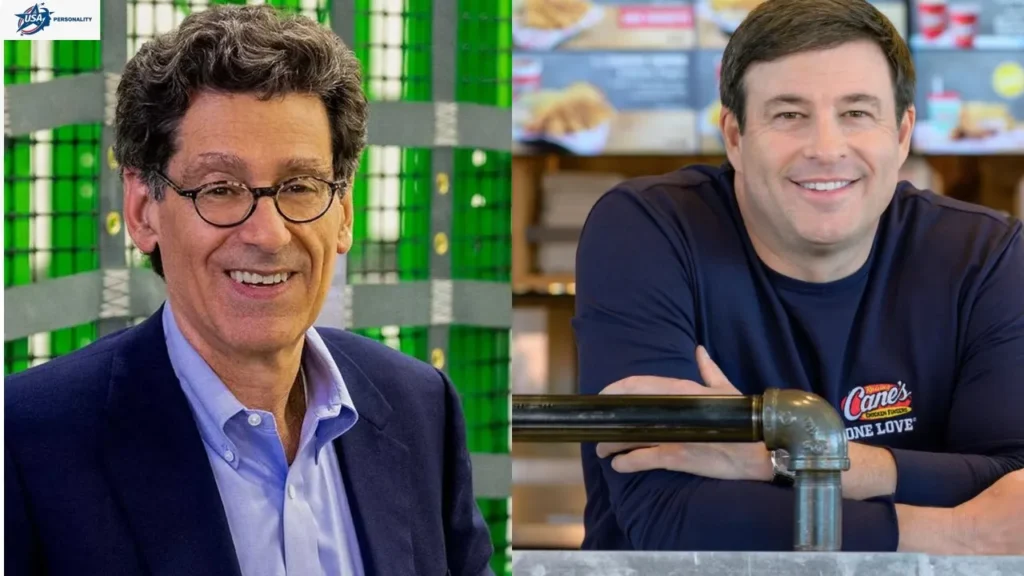
When comparing Rick Cohen & Family And Todd Graves, we are not simply comparing two wealthy entrepreneurs; we are comparing two fundamentally different models of American wealth creation.
Rick Cohen represents a hybrid structure: a legacy wholesale grocery empire (C&S Wholesale Grocers) combined with a high-technology automation venture (Symbotic). His story blends multigenerational private enterprise with modern robotics, enterprise software, and large-scale supply chain transformation. His wealth is tied to institutional contracts, capital-intensive automation systems, and technology valuation cycles.
Todd Graves represents a focused consumer brand story. As the founder of Raising Cane’s, he built a billion-dollar restaurant chain based on one idea: do one thing extremely well. His model depends on operational discipline, brand loyalty, customer throughput, and repeat transactions at the store level. His wealth is connected to unit growth, average unit volumes, and long-term brand equity.
Feature matrix concise, tabular, model-ready
| Feature | Rick Cohen & family | Todd Graves |
| Primary business | C&S Wholesale Grocers (wholesale B2B) + Symbotic (warehouse robotics/software) | Raising Cane’s (focused quick-service restaurant — B2C) |
| Net worth drivers | C&S cash flows + Symbotic equity valuation (highly time-variant) | Owner stake in Raising Cane’s; implied enterprise value from unit economics and private financing |
| Main risk | Concentrated contract exposure; tech multiple volatility | Commodity and wage inflation; franchise execution risk |
| Public profile | Low public visibility; private philanthropy | High brand visibility; media-forward CEO and marketing |
| Good for | Investors seeking asymmetric enterprise/tech upside | Investors studying brand-led growth and reliable unit economics |
Who is Rick Cohen?
Quick facts
- Name: Richard B. Cohen (Rick Cohen)
- Birth year: 1952 (approx.)
- Primary assets: C&S Wholesale Grocers (family wholesale business); founder/material backer of Symbotic (warehouse automation firm)
- Role: Executive/owner / strategic sponsor / concentrated equity holder
Biography as a structured process
Treat Rick Cohen’s biography as a hierarchical generative model: ancestral distribution (family grocery enterprise) generates an operating enterprise (C&S) that, over time, spawns a technological child process (Symbotic). The generative process involves capital allocation choices, structural inertia (legacy contracts, channel relationships), and periodic regime changes when automation adoption or technology cycles trigger revaluation.
Economic architecture
- C&S: Low margin (θ_margin small), high throughput (λ_volume large). Revenue model: many small margin transactions aggregated across outlets; earnings signal is stable but lumpy depending on customer churn and macro retail demand.
- Symbotic: Higher margin potential (θ_margin_tech larger), long implementation cycles (τ_implement long), binary high-ticket contracts (Bernoulli events with high payoff). Valuation is sensitive to market sentiment and comparables (tech multiple α).
Who is Todd Graves?
Quick facts
- Name: Todd Bartlett Graves
- Birth year: ~1972
- Primary asset: Founder & CEO of Raising Cane’s (focused QSR chain)
- Role: Founder-CEO; brand custodian; controlling owner or major stakeholder (depending on latest cap table events)
Generative story
Todd Graves initiated a high-signal, low-dimensional product hypothesis: reduce menu dimensionality to a single outstanding offering (chicken fingers) and optimize for operational reproducibility. That hypothesis yielded a set of scalable operations and strong local demand elasticities, which then drove unit expansion and brand equity accrual.
Business mechanics
- Menu simplicity: reduces operational variance (σ_ops ↓), improves repeatability.
- Unit economics: average check, throughput, and average unit volume (AUV) are primary metrics. Franchise mix and company-owned ratios act as governance knobs, altering growth vs. control tradeoffs.
- Brand elasticity: customer retention and referral convert to durable intangible assets.
Business models compared
We convert the comparative anatomy into an attribute set for ML-style reasoning.
Customer Type
- Cohen: B2B (supermarket chains, retailers) — longer sales cycles, higher AR, contract negotiations.
- Graves: B2C — high frequency, high repetition, greater marketing elasticity.
Revenue Mechanism
- Cohen: large-ticket contracts, recurring but lumpy; tech sales (Symbotic) are projectized revenue with milestone recognition.
- Graves: daily retail transactions aggregated across sites; revenue scales linearly with unit openings and same-store sales improvements.
Scalability
- Cohen/Symbotic: multiplicative scaling requires capital and long-term integration; adoption rate r_adopt depends on retailer CapEx cycles.
- Graves/Cane’s: additive scaling by store openings with shorter payback periods; staff training and site selection are primary scaling constraints.
Risk channels:
- Cohen: implementation failure, contract concentration, tech valuation drawdowns.
- Graves: commodity cost shocks (chicken feed, supply); labor cost inflation; reputational damage.
Capital intensity
- Cohen: high upfront capex for automation deployments.
- Graves: moderate capex for real estate, kitchen equipment per store.
Money talk: Net worth, valuations, and what they mean
On the nature of net-worth estimates
Net worth estimations are noisy observables derived from equity valuation models. For private entities, relies on comparable transactions or implied enterprise valuations; for public assets like Symbotic, market quotes provide higher-frequency updates but more noise.
Rick Cohen’s net worth dynamics
Rick Cohen’s is the sum of a low-variance component (C&S earnings capitalization) and a high-variance component (Symbotic public/private valuation).
Todd Graves’ net worth dynamics
Enterprise value updates come from unit expansion, AUV improvements, and external financing events. Because Raising Cane’s is often privately held or lightly traded, valuation jumps can be associated with large funding rounds or secondary share sales.
Why numbers swing: short technical note
Public market microstructure causes high-frequency variance in tech equities (Symbotic) because of liquidity, momentum, and valuation multiple repricing. Private restaurant chains experience more discrete, lower-frequency revaluations synchronized to fundraising or strategic minority-sale events.
Timeline
| Year | Rick Cohen / C&S & Symbotic (event encoding) | Todd Graves / Raising Cane’s (event encoding) |
| 1918 | Family grocery roots — ancestral distribution entity | — |
| 1974 | Rick graduates Wharton; integrates into family business (onboarding event) | — |
| 1990s | C&S scales; exploratory automation projects | 1996: First Raising Cane’s opened near LSU (market entry event) |
| 2000s | Symbotic prototyping; early adopter customers onboard | Cane’s regional expansion; operational playbook codified |
| 2010s | Symbotic secures Enterprise customers; pilots scale to deployments | National expansion accelerates; franchising framework applied selectively |
| 2021–2025 | Symbotic IPO / liquidity windows; public/equity events; backlog increases reported | Cane’s becomes national with hundreds of locations; implied valuation growth |
Deep-dive: Symbotic + C&S
System description
Symbotic is a systems integrator that bundles robots, control software, and optimization algorithms to orchestrate pallet/case movement in large distribution centers. Modules include:
- Perception and localization (robot sensors)
- Fleet orchestration and task scheduling (software scheduler, heuristics)
- Integration layer (ERP/WMS connectors)
Installation & commissioning (project delivery)
Investment thesis
- Upside vector: Automation adoption lifts labor productivity, enabling retailers to reduce operating cost per store and accelerate replenishment. Symbotic, owning proprietary hardware and software, captures a mix of upfront project revenue and recurring software/maintenance cash flow.
- Downside vector: Project risk, integration failure, and competitive displacement. A single lost major contract (e.g., a top-5 supermarket chain) can reduce expected future cash flows materially and impose a negative re-rating.
Monitoring signals for investors
- New major contract announcements (binary flags).
- Installations completed vs. backlog (throughput ratio).
- Reported implementation delays or cost overruns (adverse event flags).
- Insider selling or secondary liquidity events (supply shocks to sentiment).
Deep-dive: Raising Cane’s
Mechanism design
Raising Cane’s reduces decision complexity inside each restaurant. With a constrained action space (menu has a small cardinality), training time is minimized, throughput Q is maximized, and variance in customer experience is reduced. These factors foster replicability.
Franchise governance
Cane’s mixes company-owned and franchised stores carefully. Franchising increases growth velocity but can degrade control over marginal stores. The governance policy is a set of constraints that define franchisee selection criteria, performance KPIs, and rebuy/termination clauses.
Operational risk measures
- Commodity sensitivity: chicken cost per lb and its elasticity to EBITDA.
- Labor cost exposure:as a proportion of operating cost.
- Training throughput: new-store time-to-target AUV.
Head-to-head
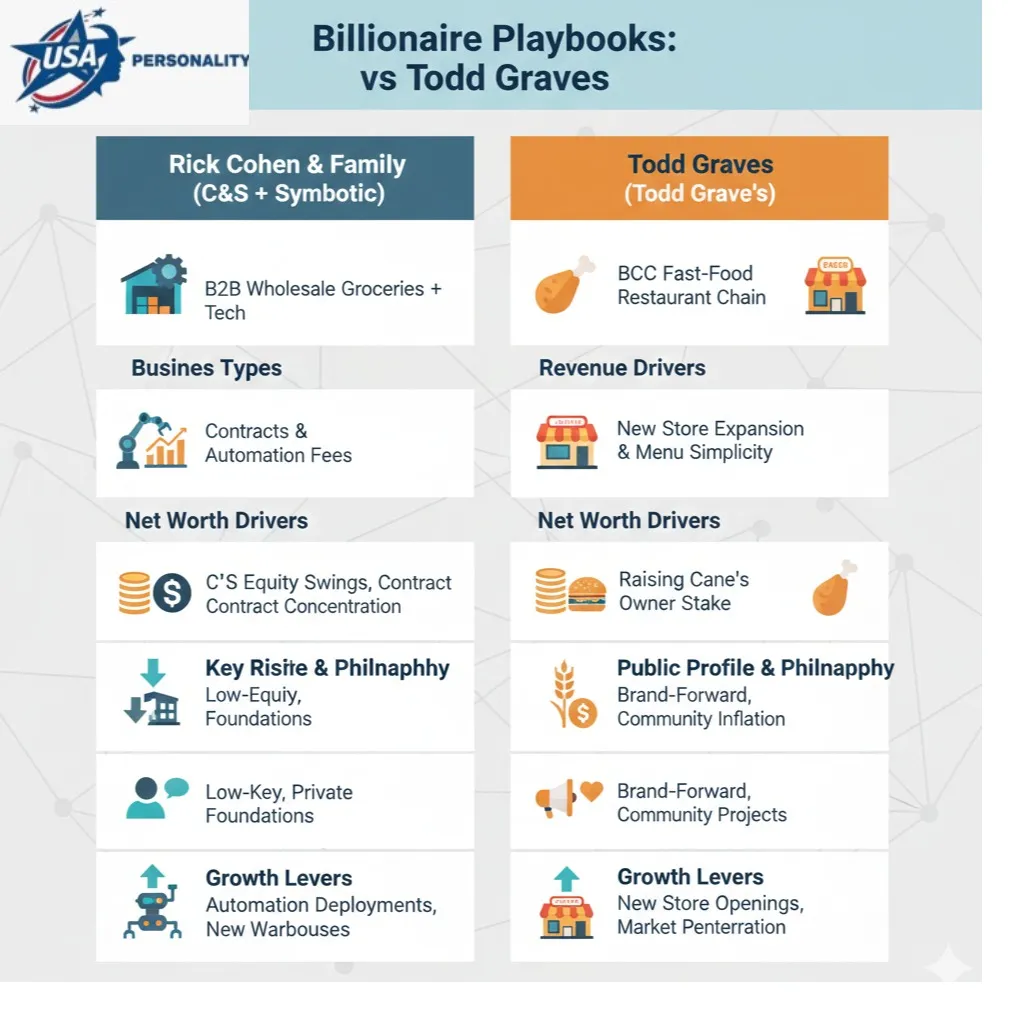
| Category | Rick Cohen & family (C&S + Symbotic) | Todd Graves (Raising Cane’s) |
| Business type | Wholesale + warehouse automation (B2B) | QSR (B2C), focused menu |
| Customer segments | Supermarkets, large retailers | Consumers, students, local communities |
| Revenue profile | Contractual, lumpy, projectized | High-frequency retail sales, per-store steady streams |
| Growth levers | Symbotic deployments, enterprise partnerships | Unit openings, same-store sales, menu promotions |
| Capital needs | High upfront for automation hardware & integration | Moderate: real estate and store buildouts |
| Valuation behavior | High variance; tech multiple sensitivity | Smoother; tied to growth and AUVs |
| Operational risk | Integration delays, implementation complexity | Commodity spikes, labor shortages |
| Public image risk | Automation-labor discourse, large-scale failures | Food quality/PR incidents affecting same-store sales |
| Investor appeal | Enterprise/tech upside, concentrated owner exposure | Predictable unit economics, strong brand loyalty |
Reputation & Philanthropy
Rick Cohen: low-touch public persona
Cohen’s public image can be modeled as visibility_score_low. Philanthropy is channeled via private foundations and institutional giving; signals are sparse, low amplitude, and often disclosed via tax filings or local press.
Todd Graves: brand-forward visibility
Graves exhibits visibility_score_high. The CEO is an active brand spokesman; marketing campaigns, sports partnerships, and local sponsorships generate constant social signals and customer-level feedback loops.
Which is “riskier”?
Define risk in two ways and compute the comparator:
- Market-value swing risk— measured by standard deviation of the owner’s estimated net worth over a rolling window.
- Symbotic introduces high due to public/tech multiples.
- Raising Cane’s owner stake has lower-frequency revaluations.
- Operational fragility— measured by the probability of day-to-day failure that reduces operating profits.
- Raising Cane’s faces higher from commodities, labor, and reputation per location.
- Symbotic/C&S has concentrated in large projects; outages are rarer but higher impact.
Decision rule: If the investor’s utility function penalizes volatility (risk-averse), Raising Cane’s appears less risky. If the downside from a single event is weighted highly, Symbotic’s concentrated, binary contract outcomes may seem riskier.
Actionable signals to watch
For Rick Cohen / Symbotic
- Press releases: new contract signings with major retailers (binary event).
- Symbotic earnings, backlog updates, and guidance (time-series).
- Insider equity transactions and lock-up expiries (liquidity signals).
- Customer concentration metrics published by C&S or public filings.
For Todd Graves / Raising Cane’s
- Same-store sales (SSS) and Average Unit Volume (AUV) disclosures.
- Pace of store openings (monthly/quarterly cadence).
- Chicken commodity price indices and hedging disclosures.
- Franchisee health indicators and turnover.
Mini case studies
Symbotic: the big contract win
Scenario: Symbotic signs a multi-year contract to automate 20 DCs for a national grocer.
Short-term effect: Backlog and revenue recognition spike; market re-rates expectations (β increases).
Medium-term risk: Implementation delays lengthen τ_implement — investors discount future cash flows; reputational risk materializes.
Monitoring: track installation milestones, customer testimonials, and on-time performance.
Raising Cane’s: rapid expansion test
Scenario: Raising Cane’s opens 100 stores in 12 months, concentrated in new geographies.
Short-term effect: Higher headline growth; staffing and training capacity tested.
Medium-term risk: If new stores underperform, brand dilution and local negative reviews lead to lower SSS and higher marketing cost to recover.
Monitoring: early 30/60/90 day AUVs, customer NPS, and local operational audits.
FAQs
A: Net worth estimates change. Both appear on billionaire lists, but exact ranking depends on the date and valuation (e.g., Symbotic share price vs. Raising Cane’s implied value). For snapshots, check Forbes and Bloomberg.
A: C&S Wholesale Grocers and Symbotic.
A: He started with a college business plan, opened the first restaurant in 1996 near LSU, and grew by focusing on one product done extremely well.
A: They have different risk types. Symbotic has execution + valuation risk; Raising Cane’s has operational + commodity risk. Your choice depends on whether you prefer tech exposure or brand/unit economics.
Practical takeaways for founders and investors
For founders
- Focus is a force multiplier. Graves’ single-product hypothesis reduced operational dimensionality and enabled consistent replication — a lesson in decision-space reduction.
- Build tech only with domain pull. Cohen’s Symbotic grew from an explicit operational need inside C&S; tech must solve a measurable pain with a credible ROI within customer budgets.
For investors
- Disentangle liquidity from intrinsic value. Public equity prices (Symbotic) are informative but noisy; private enterprise valuations (Raising Cane’s) require triangulation via transactions.
- Prioritize signals over anecdotes. New contracts, same-store sales trends, and repeatable financial metrics beat press narratives for predictive value.
Pros & Cons
Rick Cohen & family
Pros
- Exposure to enterprise automation tailwinds.
- Deep domain expertise in grocery distribution.
Cons
- Valuation swing risk tied to Symbotic multiples.
- Customer concentration adds single-contract failure risk.
Todd Graves
Pros
- Strong brand loyalty and reproducible unit economics.
- Low menu complexity reduces operational variance.
Cons
- Commodity and labor cost exposure.
- Rapid expansion risks eroding brand if governance lapses.
Conclusion
In examining Rick Cohen & family and Todd Graves, it becomes clear that there is no single “winner,” only different approaches to building sustainable wealth and scalable businesses.
Rick Cohen exemplifies the power of combining legacy enterprise with cutting-edge technology. His model leverages a long-standing grocery distribution network while creating optionality through automation, robotics, and software. The result is a concentrated but potentially high-upside portfolio, where a single major contract or Symbotic equity move can cause large swings in net worth. For investors and strategists seeking asymmetric enterprise and tech exposure, Cohen’s story provides valuable insights into concentration risk, contract-dependent upside, and integrating technology into an established business.
Todd Graves illustrates the effectiveness of radical focus, operational discipline, and brand stewardship. By perfecting a single product — chicken fingers — and expanding with a controlled mix of company-owned and franchised stores, Raising Cane’s demonstrates how simplicity, reproducibility, and customer loyalty can generate long-term wealth. For those interested in consumer-driven growth, Brand Equity, and unit economics, Graves’ journey offers a playbook on controlled expansion, menu optimization, and quality retention at scale.