Introduction
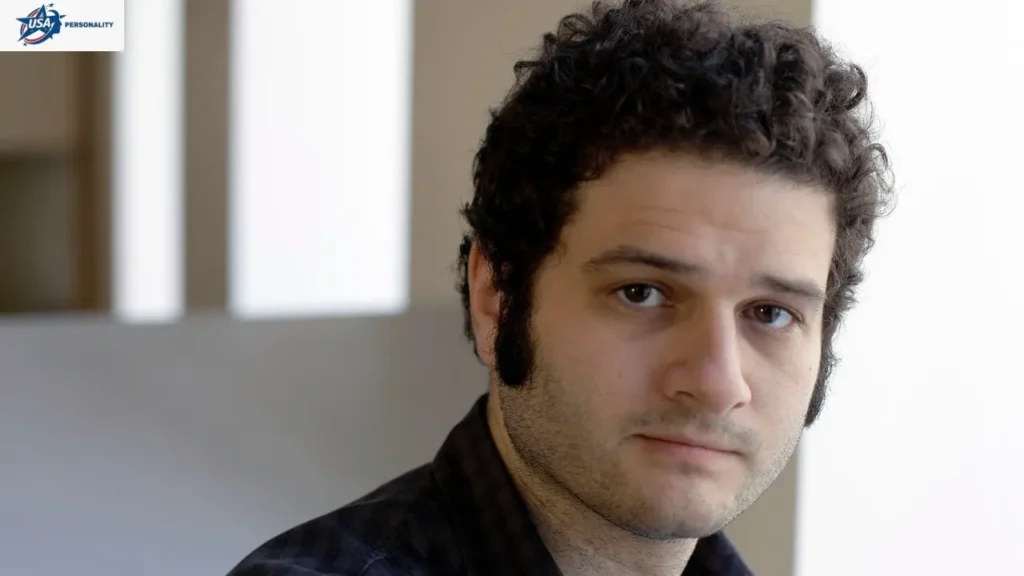
Dustin Moskovitz is an entrepreneur and philanthropist who rose to prominence as one of the original co-founders of Facebook and later as the co-founder and CEO of Asana, a productivity platform for teams. After studying at Harvard and leaving to help build Facebook in its early years, Moskovitz led engineering and product efforts before departing in 2008 to start Asana with former colleagues. At Asana, he translated lessons from rapid product iteration and systems thinking into a tool designed to reduce busywork and improve organizational clarity. Outside the tech world, Moskovitz and his wife, Cari Tuna, are active philanthropists funding global health, scientific research, and long-termist causes through Good Ventures and the Open Philanthropy Project. Today, he’s known for combining engineering-led product design with a data-driven approach to giving and institutional impact.
Quick facts
- Full name: Dustin Aaron Moskovitz.
- Born: May 22, 1984 (Gainesville, Florida).
- Age (2026): 41.
- Known for: Early Facebook engineer and VP; co-founder & long-time CEO of Asana; co-founder of Good Ventures; principal funder of Open Philanthropy.
- Education: Attended Harvard University; left to scale Facebook full-time.
- Recent notable event (Mar 2026): Informed Asana’s board he intends to transition from CEO to Chair when a new CEO is appointed. The board engaged an executive search firm. This was announced publicly by Asana.
Childhood & early life tokenization of origin story
Dustin Moskovitz’s early life encodes several attributes that later show up in his product and philanthropic priors. Born in Gainesville, Florida (1984) and raised in Ocala, he completed the International Baccalaureate program at Vanguard High School. The IB program emphasizes structured reasoning, cross-disciplinary connections, and independent research mental primitives that map directly to the systems thinking he later displayed in software and philanthropy. At Harvard he met fellow undergraduates who would become Facebook’s founding set; the dorm-room code experiments were the first training runs of a system that would generalize massively.
From Harvard dorm to Facebook core team training on a live dataset
When you treat a campus social network as a minimal viable product (MVP) and then scale it to planetary distribution, you learn how to trade off latency, feature velocity, and long-term infrastructure integrity. Moskovitz left Harvard to join Facebook full-time in 2004 and served as an early VP of engineering. His early responsibilities involved building systems and processes that supported explosive scaling: recruitment, architecture, and internal tooling. That apprenticeship trained him to value engineering leverage, product clarity, and the design of internal systems, lessons that are visible in the way he later structured Asana.
Founding Asana (2008) mission, thesis and system architecture
In 2008 Moskovitz left Facebook with Justin Rosenstein to build Asana. If Facebook was about connecting people, Asana is about connecting work: a platform intended to reduce the meta-work around coordination, communications and follow-ups, the “work about work.” The founding thesis was simple and product-level: eliminate coordination friction with a product that is fast, extensible, and integrated into existing workflows.
From an architectural perspective, Asana was designed with several explicit priors:
- Multi-view representation: List, board, timeline, calendar, and goals views to match diverse cognitive models for work.
- Automation & rules: Embed automation primitives so teams can delegate recurring coordination tasks.
- Extensible API & integrations: Allow Asana to sit in a company’s ecosystem rather than force a single monolithic workflow.
- Product-led growth: Rely on user experience and network effects inside organizations rather than an initially heavy sales motion.
This combination of design decisions reflects a systems-level approach: define primitives that map to human coordination patterns, allow composition, and then optimize for low cognitive load.
Asana product design UX, integrations, developer ergonomics
Asana’s product choices often read like a set of tradeoff rules for product teams:
- Ship small, measure impact: Prioritize features that demonstrably reduce coordination cost.
- Favor clear mental models: Let users choose views that fit their mental model of work instead of forcing a single paradigm.
- Make automation accessible: Business users can create rules without being engineers.
- Expose the platform: Robust APIs and developer tooling allow teams to integrate Asana into CI/CD, Slack, Jira, GitHub and internal tools.
Leadership style & culture product-obsessed, metrics-oriented
Moskovitz cultivated an engineering-first, product-obsessed culture at Asana. Key behavioral primitives included:
- Data-informed decision-making: decisions guided by product metrics that correlate with user value.
- Autonomy with accountability: small teams (microservices/feature teams) owned outcomes and KPIs.
- Systems thinking: process design and operating rhythms were engineered to scale as the company grew.
This leadership approach mirrors his technical priors: prefer durable systems over ad hoc hacks, measure impact, and iterate. These cultural choices made Asana a place where product work could be rigorous while staying human-focused.
Public markets and growth
Asana went public via a direct listing in 2020, an architectural choice consistent with the company’s product-first, founder-friendly identity. Going public changed the cost function facing Asana: market expectations introduced shorter-term signal noise into a long-term product development plan. From 2020 to early 2026, Asana pursued steady revenue growth, but like many SaaS companies, it faced enterprise adoption cycles, unit economics scrutiny, and investor sensitivity to guidance.
When Moskovitz announced his intention to transition away from the CEO role in March 2026, it coincided with an immediate market reaction: Asana’s stock price declined significantly following the company’s downbeat outlook and the succession announcement. Those market reactions manifest because founder transitions create uncertainty about product vision continuity and execution cadence.
March 2026 CEO succession: facts, market reaction & implications
The facts (primary source)
On March 10, 2026, Asana issued a press release stating that Dustin Moskovitz had informed the Board of his intention to transition to the role of Chair when a new CEO begins, and that the Board had retained an executive search firm to identify a successor. Moskovitz committed to remaining CEO until a successor was named. This announcement is the formal governance action.
Market reaction
The same release accompanied a revenue outlook that missed expectations, and Asana’s stock plunged more than 25% in extended trading as markets priced in both a softer near-term growth signal and founder succession uncertainty. Analysts and investors often treat founder transitions as both a governance and product-direction risk: if the founder influenced product culture and technical direction strongly, markets discount the possibility that a successor will preserve those priors. News outlets reporting on the fall in price emphasized both the weaker guidance and Moskovitz’s transition announcement.
Governance and product implications
A founder stepping back to the Chair can be neutral, positive, or destabilizing depending on the transition execution plan:
- Neutral/positive outcome: Clear succession, overlap during handover, and public communication of strategic continuity.
- Negative outcome: Abrupt departure, poor succession planning, and loss of founder credibility with engineering teams and customers.
Moskovitz indicated a desire to remain involved as Chair to contribute product vision and strategy, which reduces some tail risk; still, public markets often prefer visibility and stability during change windows.
Philanthropy Good Ventures & Open Philanthropy
Moskovitz co-founded Good Ventures with Cari Tuna in 2011. Together they have pursued a Philanthropic Strategy rooted in evidence, rigorous research, and a willingness to fund high-risk, high-reward interventions. Their partnership with GiveWell and the subsequent formation of Open Philanthropy created a distinctive model: use a research-heavy grantmaker to identify high-impact interventions and then underwrite them at scale. Good Ventures and Open Philanthropy explicitly focus on global health & development, biosecurity, climate, and long-term risks (including AI safety).
Open Philanthropy functions like an external R&D arm for large philanthropic capital: it runs diligence, builds grant portfolios, and takes long horizon bets where expected impact per dollar is high. Moskovitz and Tuna’s approach is less performative and more calibrated: metrics, transparency, and willingness to fund science and policy research that may take years to show results.
Investments & strategic bets aligning capital to system failure modes
Beyond philanthropy, Moskovitz’s private investing favors ambitious, system-level technologies — examples include climate tech and fusion energy. He has been listed among investors backing companies like Helion Energy and other deep-tech startups where patient capital is required. These bets align with a long-termist view: if the probability weighted upside of a technology (e.g., commercially viable fusion) is large, then deploying capital early is rational even if IRR horizons are uncertain.
Net worth & financial snapshot
Public wealth trackers differ in methodology (market cap of holdings, public filings, private stakes). As of mid-2026, public trackers like Forbes and Bloomberg report Moskovitz among the world’s billionaires, with figures that vary based on stock price movements and filings. For real-time net worth values, consult Forbes and Bloomberg for their latest estimates.
Asana today’s feature set, pricing & competitor comparison
What Asana is (concise)
Asana is an enterprise work-management platform that allows teams to create and manage projects and tasks with multiple views (list, board, timeline, calendar), automation, goals tracking and integrations.
High-level feature matrix
| Feature / Use Case | Asana | Jira | Trello | Monday |
| Best for | Cross-functional project tracking | Software dev & issue tracking | Simple boards & small teams | Visual workflows & dashboards |
| Views | List, Board, Timeline, Calendar, Goals | Issue lists, boards, sprints | Board (Kanban) | Boards, Timeline, Calendar, Dashboards |
| Automation & Rules | Strong (custom rules & workflows) | Strong for dev workflows | Limited without Power-Ups | Strong with templates |
| Enterprise features | SSO, Admin controls, Portfolio views | Advanced dev workflows & integrations | Simplicity; limited enterprise controls | Good enterprise features |
| Typical buyer | PMs, Ops, Marketing, cross-functional teams | Engineering teams | Small teams, personal use | SMBs & enterprises seeking visual tools |
Pros & Cons
Pros
- Product focus and engineering rigor helped build Asana into a durable product.
- Substantial philanthropic commitments focused on measurable impact.
- Patient capital deployed to long-horizon tech and climate bets.
Cons
- Low public visibility can create market uncertainty during leadership changes.
- A founder transition as CEO can cause short-term market disruption and governance questions.
Timeline of major life events
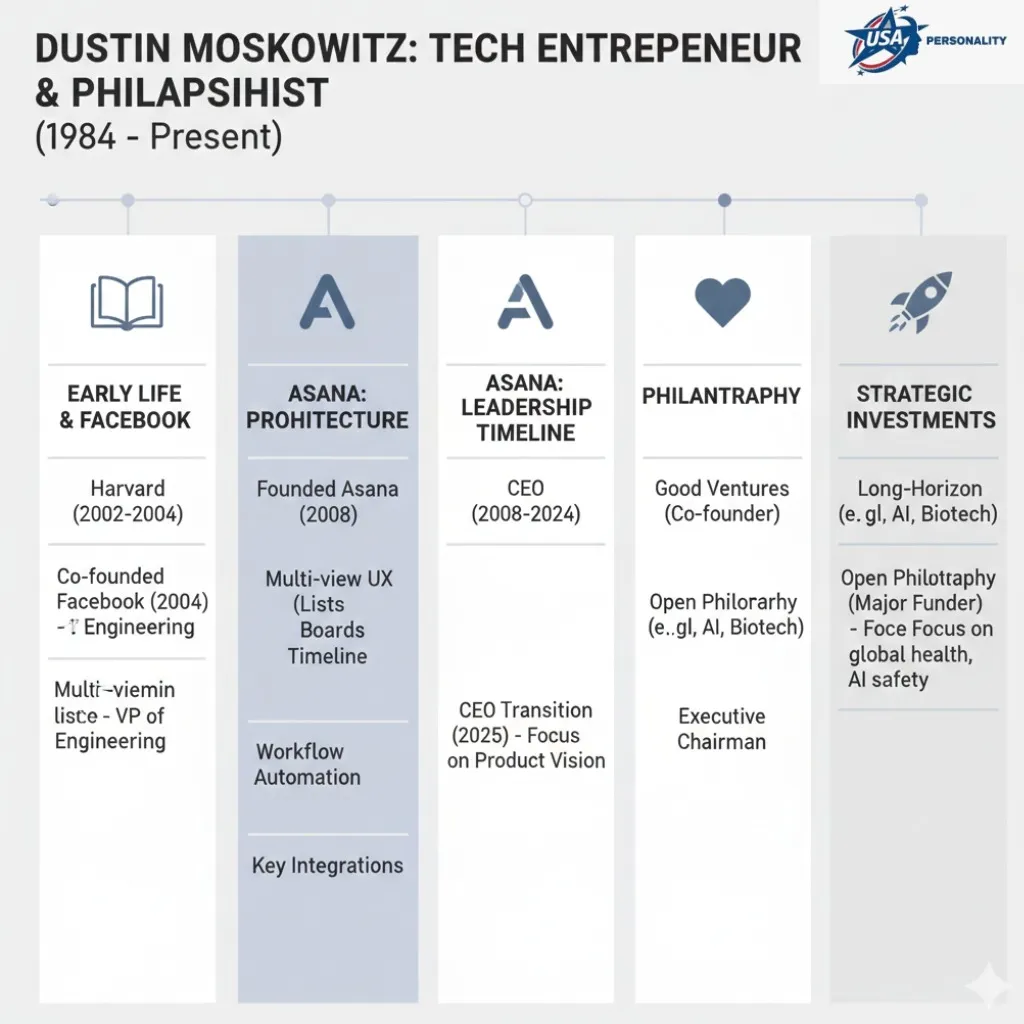
- 1984: Born May 22 in Gainesville, FL.
- 2002–2004: Harvard University; early Facebook work.
- 2004: Leaves Harvard to work full-time at Facebook.
- 2008: Co-founds Asana with Justin Rosenstein.
- 2011: Good Ventures was founded with Cari Tuna.
- 2020: Asana direct listing (public debut).
- 10 Mar 2026: Announces intention to transition to Chair when a successor is appointed; Board begins CEO search. Markets react strongly.
FAQs
A: Estimates change with markets. Trusted trackers like Forbes and Bloomberg publish current estimates and consult those pages for the latest figure.
A: He was part of the original Harvard founding team and served as an early engineering leader at Facebook.
A: In March 2026, he informed Asana’s board of his intention to retire as CEO after a successor is appointed and planned to remain chair during the transition. The board launched a CEO search; check Asana’s investor news for updates.
A: Global health, biosecurity, climate mitigation, long-termist research, and other evidence-based causes via Good Ventures and Open Philanthropy.
Conclusion
Dustin Moskovitz represents a rare archetype in Silicon Valley: the builder who matured into a systems thinker and evidence-based philanthropist. His career bridges two epochs of technology: the social networking revolution and the productivity renaissance. As he steps back from Asana’s operational Leadership, his long-term influence seems poised to deepen through governance, philanthropy, and the pursuit of effective altruism shaping not just how people work, but how capital and compassion are deployed for collective progress.