

Arthur Blank’s Empire & Impact
Arthur Morris Blank is an American entrepreneur and civic supporter whose work covers retail change, sports team ownership, and major philanthropic efforts. He helped create the “big-box” home improvement concept that grew into The Home Depot, moved into city-focused projects in Atlanta via sports and infrastructure, and now runs a family foundation providing results-driven grants. As of 2026, Blank remains a widely known public figure: his estimated wealth sits in the low double-digit billions, and his foundation announced a major $50 million pledge to support Atlanta’s historically Black colleges and universities.
Quick facts
- Full name: Arthur Morris Blank.
- Born: September 27, 1942 (Queens, New York).
- Education: Babson College (business).
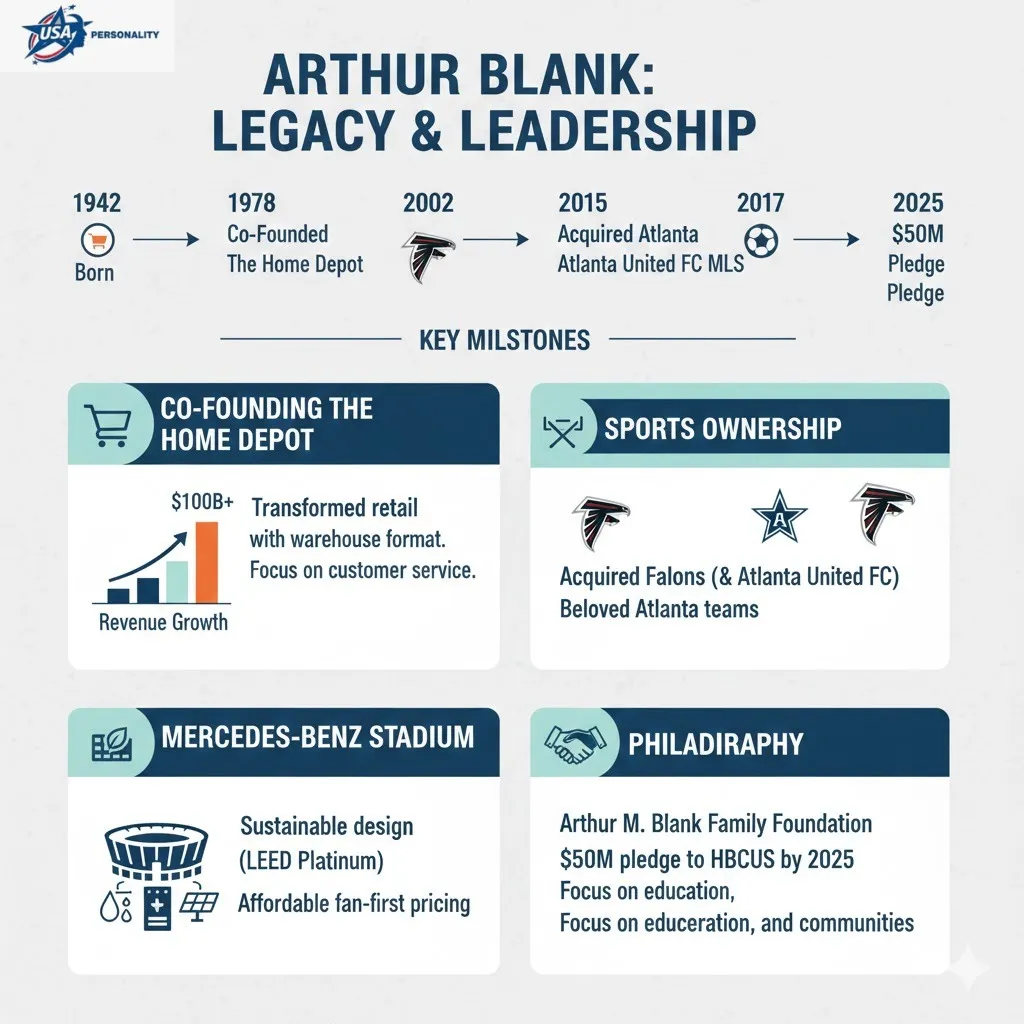
- Known for: Co-founding The Home Depot (first stores opened 1979), acquiring and keeping the Atlanta Falcons (2002), launching Atlanta United (MLS), building Mercedes-Benz Stadium, and running the Arthur M. Blank Family Foundation.
- Net worth (2026 est.): ≈ $11 billion (public estimates).
Childhood & early life: formative habits
Arthur Blank grew up in a modest family in Queens. He attended Stuyvesant High and then Babson College, where courses and early jobs strengthened his skill for operations and careful money management. Blank’s first retail positions in accounting and store tasks taught him how to manage key business levers: stock levels, workforce efficiency, and vendor deals. These insights later shaped the Home Depot model: large scale, broad selection, competitive pricing, and hands-on customer support.
From Handy Dan to The Home Depot, the idea that scaled
Blank’s direct line to The Home Depot begins in the retail trenches. In the late 1970s, he and Bernie Marcus were executives at Handy Dan; after they were dismissed in 197,8 the two used the setback as a catalyst to create a very different retail format: warehouse-scale home Improvement Stores with vast selection, aggressive pricing, and knowledgeable associates on the sales floor. The model’s first manifestations opened in Atlanta on June 22, 1979, and the results reshaped how Americans buy materials and tools for projects.
The Home Depot playbook shows how the model worked
Blank and his co-founders built a repeatable system that allowed the company to scale rapidly. The essential elements were straightforward:
- Warehouse scale + wide assortment. A single store housed thousands of SKUs so customers could find most project needs in one trip.
- Economies of scale for low prices. By buying in bulk and standardizing purchasing, the chain pressured supplier margins and passed savings to customers.
- Frontline expertise. Stores invested in training and empowered associates to help do-it-yourself customers succeed, turning product retail into practical problem-solving.
- Operational discipline. Systems for inventory, logistics, and new-store openings made explosive growth repeatable.
Those components turned The Home Depot into a national retail platform and created the wealth base that would later fund Blank’s civic investments.
Executive transition & AMB Group
Blank served in senior operating roles at Home Depot for many years before stepping back from daily management around the early 2000s. After leaving active operational leadership, he consolidated his investments under AMB Group (often called the Blank family of businesses), a vehicle that would manage sports holdings, stadium operations, real estate (including ranch and hospitality assets), and other diversified investments. The AMB structure allowed professional governance of business assets while maintaining a family office approach to long-term projects and philanthropy.

Sports ownership: Atlanta Falcons & Atlanta United
Blank’s 2002 acquisition of the Atlanta Falcons marked an important business and civic milestone: it kept the team in Atlanta and gave him a platform to support city Development and local programs. Under his leadership, the ownership group launched Atlanta United (Major League Soccer), which quickly became one of the league’s top expansion successes by combining smart sports management with strong fan engagement and a lively downtown stadium setting.
Mercedes-Benz Stadium’s sustainability and civic value
A key project in Blank’s civic portfolio is Mercedes-Benz Stadium, which he backed as a purposefully modern, green venue meant to serve fans and the broader community. The stadium emphasizes energy saving, solar electricity, and water reuse:
1: About 4,000 solar panels generate over a million kilowatt-hours yearly, enough to power multiple home games.
2: A large on-site water tank (storing hundreds of thousands of gallons) and advanced rainwater systems collect and reuse rain for irrigation and cooling needs.
3: Eco-friendly design features cut overall electricity consumption compared with older traditional stadiums.
The stadium also works as a community hub: it hosts local events, builds job paths through stadium programs, and draws nearby economic activity.
Philanthropy: Arthur M. Blank Family Foundation strategy & scope
Blank’s philanthropic work is run mainly through the Arthur M. Blank Family Foundation, which distributes grants in areas such as education programs, health care, arts projects, community rebuilding, youth initiatives, and sports workforce efforts. Over decades, the foundation has provided funding and program support totaling billions, including capital investments, program assistance, scholarships, and institutional grants.
A major part of the foundation’s strategy is results-focused giving: grants are usually structured with measurable goals, like graduation success, job placement, or clear operational milestones, rather than unrestricted donations. This approach reflects Blank’s system-oriented mindset: define benchmarks, review programs, and expand what succeeds.
The 2026 HBCU pledge what it is and why it matters
In October 2026, the Arthur M. Blank Family Foundation revealed a $50 million pledge to historically Black colleges in Atlanta, including Clark Atlanta University, Morehouse College, Morris Brown College, and Spelman College. The ten-year plan supports “gap scholarships” meant to help nearly 10,000 students who are academically eligible but risk leaving before graduation due to missing funds. Foundation leaders described the gift as both an equity investment and a results tool: raise graduation rates, improve lifetime earnings for scholars, and strengthen institutions that develop civic and professional leaders.
Why this matters:
1:Targeted student effect: By focusing on near-graduates, the program aims to deliver high returns. A single semester of support can turn a near-completer into a degree holder.
2: Institution ripple effects: Higher completion rates boost alumni pipelines, philanthropy narratives, and long-term school stability.
3: Local economic gains: Degrees usually increase lifetime earnings and community economic participation, which further enhances regional prosperity.
The pledge received wide attention due to its size and strategic intent; many observers saw it as the foundation reinforcing education and equity efforts in Atlanta specifically.
Timeline key milestones
- 1942: Born in Queens, New York.
- 1963 (approx.): Graduated from Babson College.
- 1978: Laid the groundwork to found The Home Depot after leaving Handy Dan.
- 1979 (June 22): First Home Depot stores open in Atlanta.
- 2002: Purchased the Atlanta Falcons.
- 2017–2024: Ongoing civic and stadium initiatives; awards and recognition for sports and community leadership.
- 2026 (Oct): $50M HBCU pledge announced.
Net worth & holdings
Publicly available billionaire lists and business profiles place Blank’s net worth at around $11 billion in 2026. His sources of wealth include founder equity from The Home Depot, diversified investments via AMB Group, sports franchise valuations (Atlanta Falcons, Atlanta United), real estate assets (including hospitality and ranch holdings), and other private investments. Because much of this value is tied to legacy holdings and illiquid assets, the headline number is an estimate that changes with market valuations.
Major achievements & recognitions
- Launching The Home Depot and creating the big-box home improvement model that transformed a national market.
- Maintaining the Atlanta Falcons in Atlanta and funding local infrastructure and community initiatives.
- Building Mercedes-Benz Stadium as a LEED-focused, eco-conscious civic venue.
- Executing multi-hundred-million-dollar philanthropic programs through the family foundation over decades, now including a major $50M HBCU commitment.
Controversies & legal notes
High-profile founders and family offices sometimes wind up in public disputes or legal matters tied to businesses or personnel. Reporting has covered employment claims and occasional legal disputes involving organizations connected to the family or their businesses. When publishing these items, best practice is to present the case facts, cite the original reporting and legal filings, and include official responses or corrective statements from the organizations involved. Avoid conjecture; focus on verifiable documents and statements.
Measuring philanthropy: outcomes, not just dollar totals
For publishers and analysts who want to turn the $50M headline into meaningful reporting, frame the gift with outcomes and plausible impact metrics:
- Students served: The foundation estimates targeting nearly 10,000 students over ten years. Use that figure as the program denominator for results.
- Graduation lift: Use conservative academic estimates for the lifetime earnings delta of degree completers versus non-completers to estimate economic benefits (cite economic studies when publishing).
- Local tax and multipliers: Model how increased degree attainment expands earnings and local spending, and use municipal multiplier frameworks to estimate incremental tax revenues and economic output.
This approach makes the story evergreen: not just a gift, but a projected set of measurable social returns.
Leadership style: short lessons for founders
Arthur Blank’s public record suggests several recurring leadership themes relevant to entrepreneurs:
- Systems before scale: Invest in processes and repeatable playbooks before opening many locations.
- People as an advantage: Train front-line staff and transfer judgment; the company’s customer service differentiator was human expertise as much as product range.
- Use capital for public value: Large projects, stadiums, hospitals, and education can be structured to deliver local benefits when paired with programs and workforce pipelines.
- Professional governance: Shift from operator to steward with formalized governance structures for long-term continuity.
These lessons are practical: they translate operational priorities (inventory, training, logistics) into civic outcomes (jobs, scholarships, institutional capacity).
Tables & Comparison
| Focus area | Primary objective | Measured outcomes |
| Business (Home Depot, AMB) | Scale, margins, customer experience | Store count, revenue growth, and Brand Value. |
| Sports & Stadiums | Fan experience, civic development | Stadium sustainability metrics, local hiring, event counts. |
| Philanthropy | Education, health, community | Grants deployed, scholarships, and graduation rates. |
FAQs
A: Arthur Blank co-founded The Home Depot with Bernie Marcus; the first stores opened on June 22, 1979.
A: Public estimates place his net worth around $11 billion in 2026. These numbers come from financial rankings and can shift with market valuations.
A: The Arthur M. Blank Family Foundation supports education, health care, community revitalization, the arts, and workforce programs. In 2026, the foundation pledged $50M to Atlanta HBCUs.
A: He bought the Atlanta Falcons in 2002.
A: The stadium is known for its sustainability features, including thousands of solar panels, large water capture cisterns, and an energy-saving design that reduces energy use relative to older stadiums.
Conclusion
Arthur Blank’s story shows how operational skill converts into civic value: from creating efficient systems and large-scale operations at Home Depot to planning community-based projects and results-focused philanthropy in Atlanta. The 2026 $50 million gift to Atlanta HBCUs highlights a precise, goal-driven funding strategy aimed at measurable outcomes. For business founders: develop repeatable processes, invest in staff, and consider how resources generate tangible public benefits. For writers and reporters: focus on primary sources, Local Impact, and measurable results to make coverage reliable and lasting instead of temporary.