

Pamela Mars: Leadership & Legacy
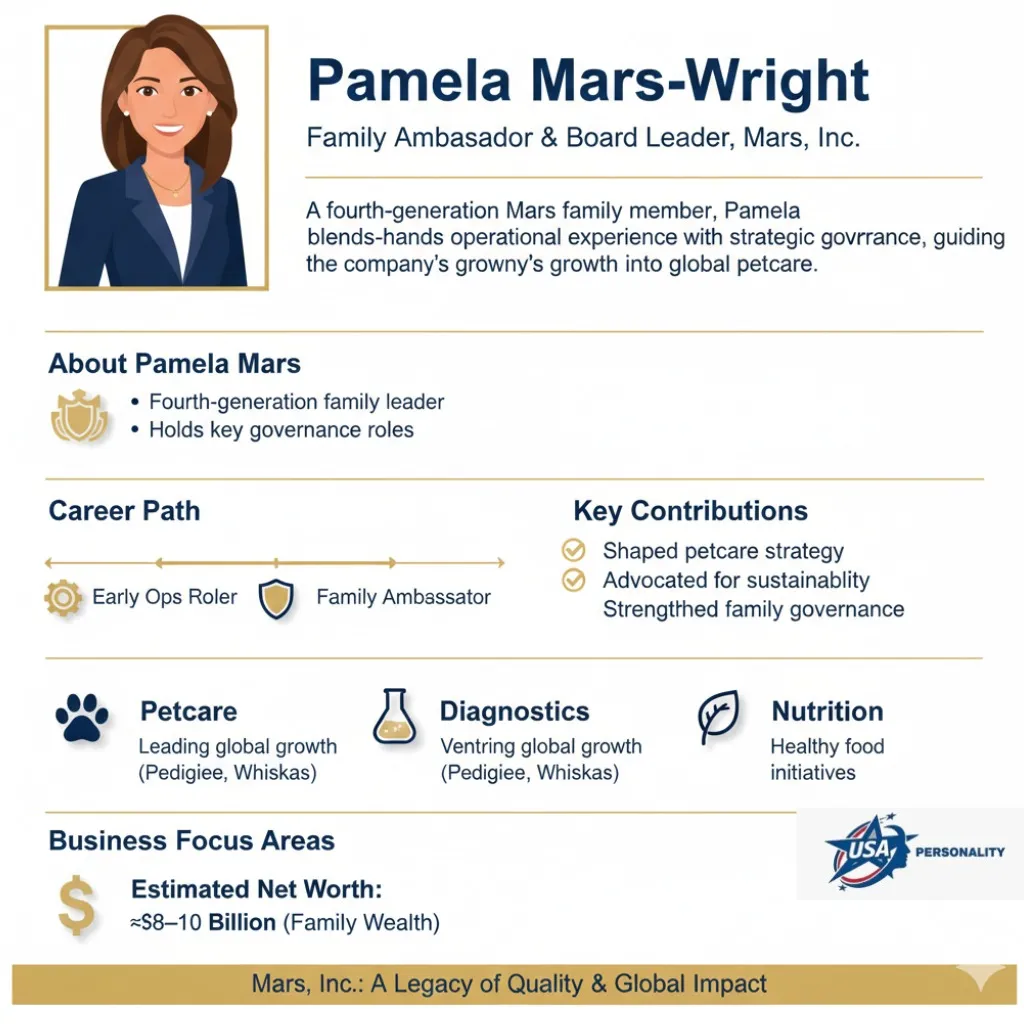
Pamela Mars Wright works in a fourth-generation family, combining hands-on skills with executive guidance. She started ground-level tasks, then rose to board member at Mars company, directing growth toward the global pet-care field, covering animal health, testing labs, and food solutions. This visual overview shows her career path, major accomplishments, main business areas, and wealth profile.
Quick facts
- Full name: Pamela Diane Mars-Wright.
- Born: circa 1960 (approx.).
- Nationality: American.
- Education: Vassar College (BA); Foxcroft School (secondary).
- Started at Mars, Inc.: 1986 (operations roles).
- Board & Chair: Board member from 2001; reported chair in mid-2000s (circa 2004–2008).
- Family: Daughter of Forrest E. Mars Jr. (1931–2016); one of the sisters who inherited a material stake.
- Estimated stake inherited (2016): ~8% (reported).
- Estimated net worth (2026): roughly US$10–11.5 billion (estimates from financial trackers).
Why Pamela Mars matters
Pamela Mars stands apart as she blends two roles rarely paired: family heir with solid hands-on operations know-how, plus experienced governance guide. She moved from plant levels up to the executive team, earning trust among workers and practical knowledge of product making, plus global scaling. Crucially, she links tightly with the family’s main push into the pet-care sector, a fast-growing field with recurring revenue that reshaped Mars growth story and family wealth. For journalists, investors tracking private-company control, and business historians, Pamela shows how family leadership can shift traditional consumer firms into new, lasting markets.
Early life & education
Family roots
Pamela grew up in the Mars family, the lineage behind famous treats like Snickers and M&Ms.Her dad, Forrest E. Mars Jr., played a key role in both family and company. The Mars clan is known for valuing discretion; they usually avoid public spotlight and keep business and family matters private. That setting shaped Pamela’s approach: low profile, strong stewardship.
School & Vassar College
Pamela went to Foxcroft School, an all-girls boarding academy, then earned a bachelor’s degree from Vassar College, a liberal-arts college.That broad schooling stands out: many heirs join family firms after vocational or business programs, while liberal-arts training can foster critical thinking and a systems perspective useful for later running complex global operations.
Starting at Mars, Inc., from operations to leadership
Joining the company (1986)
Instead of taking an immediate desk job within the Family enterprise, Pamela Mars began in operations in 1986. She worked as an operations supervisor and later as a plant director at a pet-care manufacturing facility. Her early career also included serving as manufacturing director in Australia. These roles gave her hands-on experience in production, supply chains, and frontline management, the sort of credibility that’s essential when family members oversee large workforces.
Why starting in operations matters
- Credibility: Being in production makes it easier to earn trust from career employees.
- Systems view: Operations teach the mechanics of how product, people, and processes align.
- Global exposure: Time in Australia and other sites gave her an international perspective on scaling and complexity.
From the floor to the boardroom
After many years in operations, Pamela became a board member in 2001.This move from hands-on work to governance is a common path for family heirs who want to fully grasp the business before guiding long-term plans.

Board service and chairmanship governance style
Board member (2001) and chair (2004–2008)
Pamela’s service on the Mars, Inc. board began in 2001. Public reports commonly cite her as chair from 2004 to 2008. In governance, she has been described as favoring quiet stewardship and long-horizon planning characteristics typical of family-run enterprises that prioritize continuity over short-term market optics.
External board roles
Outside Mars, Pamela has appeared in public profiles as serving in supervisory roles at companies like Heineken N.V. Taking external positions gives family leaders experience with governance frameworks outside their own firm and helps them bring best practices back to the family business.
Governance approach
- Quiet stewardship: The family avoids headlines; governance is pragmatic and private.
- Long horizon: Decisions focus on decades, not quarters.
- Sustainability & resilience: Emphasis on responsible sourcing, workplace stewardship, and long-term brand equity.
Petcare strategy: why Mars, Inc. moved beyond candy
The strategic logic
Candy and snacks are stable but relatively mature markets. Petcare provides a different profile: higher margin opportunities, recurring services (veterinary care), and resilience to commodity swings. Owning pet-food brands is one thing; owning veterinary networks and diagnostics is another. The latter creates sticky revenue through recurring clinical services and diagnostics that deepen customer relationships.
Pamela’s role as a family ambassador to PetCare
In public, Pamela is called a family envoy to the petcare unit. This job usually includes representing the clan in strategy talks, reviewing big deals for alignment with family aims, and making sure petcare growth matches principles like animal health and sustainability. While company deal teams handle execution, family envoys link the family’s long-term vision with business plans.
Why families pivot to adjacent sectors
- Diversification: Reduce dependence on one product or category.
- Capability transfer: Apply consumer-marketing, R&D, and supply-chain know-how to new categories.
- Recurring revenue: Services and vet care produce regular customer contact and revenue streams.
Major petcare deals: VCA, AniCura, Linnaeus, what they mean
VCA (2017)
- What happened: Mars acquired VCA Inc., a large chain of animal hospitals in North America, in a multibillion-dollar deal announced in January 2017.
- Why it mattered: The deal instantly gave Mars a leading services arm with recurring revenue and tens of millions of pet-patient encounters each year. It transformed part of the Business Model from products-only to services + diagnostics + care.
AniCura (2018)
- What happened: Mars expanded into Europe with the acquisition and integration of AniCura, a network of specialty and general veterinary hospitals.
- Why it mattered: AniCura broadened Mars’s geographic footprint in animal health and deepened the company’s clinical capabilities in Europe.
Linnaeus & other regional networks
In the UK and other markets, Mars incorporated established veterinary groups (Linnaeus among them), rounding out regional strength and ensuring Mars had both retail (pet food) and clinical (vet) touchpoints with pet owners.
Strategic impact
These acquisitions are not isolated transactions; they created a global platform spanning nutrition, diagnostics, clinics, and specialty care. That vertical integration increases customer lifetime value and makes Mars a dominant force in pet health.
Ownership & Net Worth: How the wealth breaks down
Private company, public estimates
Mars, Inc. is privately held. That means no single public market price exists for the company. Financial outlets estimate company value and then apply reported ownership shares to estimate individual net worths. These are well-informed approximations but not audited facts.
The 2016 inheritance event
When Forrest E. Mars Jr. passed away in 2016, his stake was reportedly inherited by his daughters. Public reporting commonly cites that each daughter received a substantial percentage (often quoted around ~8% per sister). That event materially changed public estimates of family wealth.
Net worth estimates (2026)
Major wealth trackers placed Pamela’s net worth in the US$10–11.5 billion range in recent years (estimates vary by methodology). Remember: these are derived by estimating the company value and multiplying by an individual’s share, so margins of error exist.
How to interpret these numbers
- These numbers are rough, not audited records.
- Private firm appraisals use sales and profit multiples, comparisons, and known deals.
- Ownership portion matters more than roles: a small slice of a very big private company can make billionaire-level wealth.
Philanthropy, privacy, and public profile

Low public profile, high private impact
The Mars family is famously private; Pamela follows that pattern. She tends not to court publicity, instead participating in family philanthropy and corporate sustainability work behind the scenes.
Philanthropic priorities
Public details about Pamela’s personal giving are limited. Historically, the Mars family has supported Education, health, conservation, and research. At the corporate level, Mars, Inc. has public sustainability targets (e.g., responsible sourcing, animal welfare) that align with the family’s stewardship ethos.
Simple timeline
| Year | Event |
| ~1960 | Pamela Diane Mars-Wright was born (approx.) |
| 1986 | Joins Mars, Inc. in operations (operations supervisor) |
| 1990s | Manufacturing roles, including leadership in Mars Australia |
| 2001 | Appointed to the Mars, Inc. board of directors |
| 2004–2008 | Reported to have served as chair of the board |
| 2016 | Forrest E. Mars Jr. dies; daughters inherit stake (~8% each reported) |
| 2017 | Mars completes acquisition of VCA (announced Jan 2017) |
| 2018 | Mars completes acquisition of AniCura (announced mid-2018) |
| 2020s | Pamela serves as family ambassador to Mars Petcare; net worth estimates in the US$10–11B range |
Pros & Cons
Pros
- Practical experience: She served in operations and production, giving real-world credibility.
- Board role: Director and chair posts give sway over planning and oversight.
- Strategic fit: As family envoy to petcare, she helps match the family with a fast-growing segment.
Cons
- Privacy limits transparency: The Mars family’s guarded public presence means fewer direct quotes and fewer public records detailing specific decisions.
- Estimates, not audited figures: Net Worth and exact ownership percentages are analyst estimates.
How to read headlines about the family
Be skeptical of claims that single family members “caused” a particular move. Large private conglomerates make many decisions collectively, and corporate executives often execute deals. Family members typically set direction, values, and stewardship priorities.
Examples & comparisons
Example: Traditional heir vs. operations-first heir: Some heirs join the enterprise in executive or financial roles only. Pamela’s path (operations → board) is like learning to drive before owning a car; you lead with experience.
Example: Why petcare is smart: A company selling snacks can also sell pet food; owning veterinary clinics creates recurring appointments and diagnostics revenue. That repeat business is less cyclical and more predictable.
FAQs
A: Pamela Diane Mars-Wright is a fourth-generation member of the Mars family, a former chair of Mars, Inc.’s board and currently a family ambassador to the Mars pet-care division.
A: Exact numbers are hard because Mars, Inc. is private. Major indexes estimate her net worth in the US$10–11.5 billion range based on ownership and private-company valuations.
A: She graduated from Vassar College.
A: She serves as a family ambassador to the Mars Petcare division and supports the family’s strategic interest in pet health. The company’s acquisitions of major veterinary networks align with that strategic push.
A: Public profiles list her as a supervisory board member at Heineken N.V. and other external governance roles.
Conclusion
Pamela Mars demonstrates a rare mix of hands-on production skill, steady family oversight, and targeted push into growing areas, especially the Mars Petcare unit. Her path from plant floors up to the company board shows practical leadership: she learned operations from the base level, then guided strategy from the governance seat. This combination matters because it builds confidence within staff and provides a wide outlook for choosing investment moves and growth goals.
Through family guidance and key buys like VCA, AniCura, and regional vet networks, Mars shifted its main growth engine from candy to animal health and care services. Pamela serves as a family bridge to the petcare unit, supporting the change: she ensures clan values, sustainability aims, and long-view planning while the firm merges clinics, lab tools, and feeding lines into one pet-health platform.
Since Mars stays private, numbers like stake share, company value, and Personal Wealth remain rough estimates. Yet core facts remain: owning part of a large private firm, plus careful governance and strategic bets on recurring-income services, places Pamela among the top family leaders in modern consumer and pet-health strategy. For writers and media, the main takeaway is simple: treat Pamela Mars as an oversight-minded leader who helped move a traditional consumer firm into a new petcare stage, reshaping company growth and family wealth.