Introduction
Wealth is often measured in static numbers, but influence is dynamic. Miriam Adelson and Phil Knight both belong to the world’s most prominent billionaire families, yet their paths to power and the mechanisms through which they exercise it could not be more different. Adelson’s authority stems from concentrated control over high-stakes, capital-heavy casinos and strategic political contributions that yield immediate, measurable impact. Knight, by contrast, wields influence through a globally recognized brand, liquid equity holdings, and massive, institution-focused philanthropy that reshapes the landscape of education, medicine, and public research.
By 2026, both families occupy similar financial brackets, but their strategies reflect fundamentally different philosophies of legacy. Adelson’s model is fast-acting, leveraging political networks and regulatory exposure to shape outcomes in real time. Knight’s model is slower, building structural influence through philanthropy, brand loyalty, and institutional embedding that endures for decades.
This analysis examines their wealth, governance, and giving patterns through a modern lens conceptualizing assets as networked features, influence as adjustable weights in public perception, philanthropy as enduring memory storage in social systems, and succession as carefully orchestrated governance architectures. By mapping these families’ influence in this way, we reveal who is more likely to hold durable sway over business, politics, and society, and how concentrated wealth can be transformed into both immediate power and long-term legacy.
Quick facts
Miriam Adelson & Family
- Full name: Miriam Adelson (née Farbstein)
- Born: October 10, 1945 (age 80 in 2026)
- Nationality: Israeli–American
- Primary asset: Majority stake in Las Vegas Sands (LVS) casino & resort operator.
- Other public profile pieces: Owner of the Dallas Mavericks (acquired 2023).
- Estimated net worth (2026): low–mid $30s billion (trackers vary).
Phil Knight & Family
- Full name: Philip Hampson Knight
- Born: February 24, 1938 (age 87 in 2026)
- Nationality: American
- Primary asset: Founder legacy and substantial shareholdings in Nike, Inc. (family holdings and trusts).
- Estimated net worth (2026): ≈ mid $30s billion (Forbes/trackers vary).
Why compare these two families?
At surface level, casinos and athletic footwear seem unrelated. But both families are archetypes of concentrated private wealth that shape public life. The comparison is instructive because it isolates how asset composition, liquidity, governance, and donation strategy map to different forms of influence: rapid, tactical political leverage (Adelson) versus slow, structural institutional change (Knight).
Part I Miriam Adelson: physician → casino principal → political power broker
Early life & transformation
Miriam Adelson trained as a physician in Israel; her professional origin becomes an important contextual feature for interpreting early philanthropic preferences (health-related philanthropy, medical schools) and for narrative framing in the public record. After marrying Sheldon Adelson, her public role shifted from practitioner to principal shareholder and estate executor. That transition converts private biography into an ownership signal that amplifies political and regulatory salience.
How the fortune was built Las Vegas Sands & holdings
Sheldon Adelson built Las Vegas Sands into a globally significant casino operator with major properties in Macau, Singapore, and the U.S.; after his 2021 death Miriam became the most visible family shareholder and executor of the Adelson estate. LVS’s capital intensity and reliance on tourism, cross-border travel, and licensing makes it a high-variance feature in any forward prediction of family wealth and influence: regulatory shocks or travel disruptions propagate strongly through LVS earnings and public perception.
Dallas Mavericks: cultural signal & media exposure
The 2023 acquisition of the Dallas Mavericks (an NBA franchise) adds a high-visibility media node to the family graph: sports franchises are not only financial assets but cultural amplifiers that change how a family appears in popular attention and brand networks. This asset increases soft power (celebrity bridging, sponsorship networks) but also exposes the family to cultural controversy and fan sentiment dynamics.
Political giving as strategic influence
The Adelson name is tightly associated with substantial political donations to conservative causes and pro-Israel organizations. In algorithmic terms, political contributions act like a high learning-rate optimizer: they produce immediate parameter changes in electoral and policy outputs (e.g., candidate viability, ad saturation, lobbying effectiveness). But high learning rate also risks overshooting: donations invite scrutiny, backlash, or regulatory countermeasures that can amplify negative gradients (reputational loss, investigations).
Business posture & strategic risks
Because LVS depends on tourism and regulation, the Adelson position is sensitive to:
- Macau policy & China travel patterns (geopolitical covariance)
- U.S. tourism cycles and macro downturns (systemic risk)
- Regulatory or reputational blowback tied to political activity
Concentration of ownership yields quick decision-making and control (fast inference), but a concentrated position increases downside variance if the core asset’s distribution shifts unfavorably.
Succession & governance
After Sheldon’s death, control mechanisms have remained tightly held through boards, voting agreements, and trusts. This is effectively an ensemble of governance rules that preserves strategic continuity; yet entrusting influence to family-controlled structures can create brittle points (single-point failures) if estate taxes, litigation, or successor disputes change the architecture.
Part II Phil Knight: the brand, the philanthropy, the institutional model
From Blue Ribbon Sports to Nike
Phil Knight co-founded Blue Ribbon Sports in 1964; it became Nike and achieved global brand-scale. In NLP terms, Nike is a massive embedding in cultural, athletic, and consumer language spaces: its logo, athlete endorsements, and campaigns are recurring tokens across decades of media. That cultural embedding amplifies residual value in ways that pure financial metrics don’t fully capture.
Wealth mechanics public shares & liquidity
Nike is publicly traded; Family Wealth is held largely as equity and trusts. Public shares are liquid features (they can be transacted without immediate loss of price discovery at small volumes), which reduces single-asset concentration risk versus private holdings. Founder-class shares or control vehicles can retain board influence while allowing wealth diversification.
Philanthropy as long-term power the $2 billion pledge
In August 2026 Phil and Penny Knight announced a $2 billion pledge to the Oregon Health & Science University (OHSU) Knight Cancer Institute described by the university and press as a historic, record gift to a U.S. university or academic health center. Large, institutionally directed gifts are analogous to memory consolidation in neural networks: they harden patterns (infrastructure, research agendas, governance roles) that persist across many training cycles (decades). The 2026 pledge is a clear example of converting wealth into a durable capacity-building vector.
Institutional vs political influence
Knight-style giving builds enduring institutional capacity naming rights, endowments, boards, and research programs which are sticky (hard to reverse without renegotiation). Political donations, by contrast, are like short-term gradient updates. Knight influence is slower to appear but more persistent once integrated into institutional governance.
Brand risks & reputational exposure
Nike faces brand risks: supply-chain scrutiny, labor controversies, and marketing backlash. These are analogous to adversarial examples that can temporarily reduce model confidence (consumer demand); yet a deeply entrenched brand and global market can provide robustness and recovery pathways. Philanthropy also functions as a regularization term that offsets reputational noise by adding public-benefit signals.
Head-to-head comparison
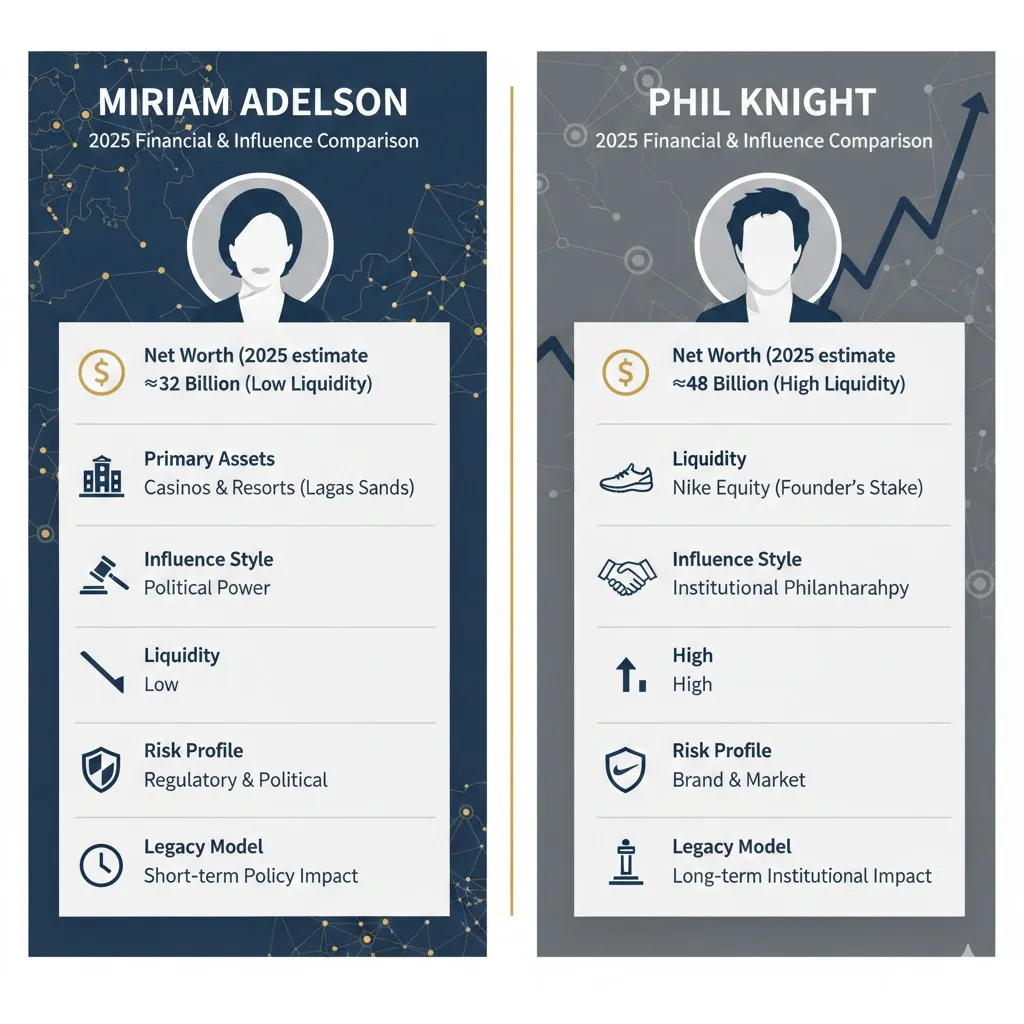
| Dimension | Miriam Adelson & family | Phil Knight & family |
| Primary asset | Majority stake in Las Vegas Sands (casinos, resorts). | Nike founder equity and family shareholdings (public). |
| Net worth (2026 est.) | Low–mid $30s billion (trackers vary). | ≈ mid $30s billion (Forbes/trackers vary). |
| Influence style | Political donations + concentrated corporate control. | Institutional philanthropy + brand/cultural influence. |
| Liquidity | Lower (concentrated private assets). | Higher (public shares). |
| Risk | Regulatory, political, tourism cycles. | Brand & market cycles; reputational issues. |
| Succession | Family-controlled stake; concentrated governance. | Foundations & trusts; dispersed corporate control with founder influence. |
Deep dive what net-worth numbers miss
Net worth is a scalar projection of many latent variables. Treat it as a single coordinate in a high-dimensional space. Three vectors are often under-weighted when readers make quick judgments:
- Asset composition (feature vector): Is wealth concentrated in a private, capital-intensive company (Adelson/LVS) or in liquid, public shares (Knight/Nike)? Concentration increases exposure to idiosyncratic shocks; liquidity affects optionality (ability to deploy capital quickly without severe price impact).
- Governance & control (architecture): Who holds voting power individuals in family trusts or dispersed shareholders with founder control mechanisms? Tight control enables rapid strategic choices (e.g., political donations, asset divestitures) while distributed control reduces the chance of single-actor mistakes but can slow action.
- Leverage of influence (attention mechanism): How is money converted into public outcomes? Political donations generate sharp, measurable policy effects in the short term; institutional gifts create persistent capacity (research programs, endowed chairs) that change the policy and knowledge landscape slowly but durably. The Knight $2B gift is a prime example of the latter.
Philanthropy compared short-term policy vs long-term capacity
- Adelson giving: Heavy weighting toward political contributions and organizations aligned with particular policy outcomes. This is a high-frequency influence channel fast, targeted, and measurable but it invites regulatory and reputational feedback loops.
- Knight giving: Monumental institutional gifts to universities and medical research (e.g., $2B to OHSU in 2025) are low-frequency, high-durability interventions that embed the donor name and governance influence into public infrastructure.
Pros & cons
Miriam Adelson & family
Pros
- Concentrated control enables fast strategic moves (high update velocity).
- Political networks provide direct levers in policy and appointments.
Cons
- High regulatory and reputational risk due to political visibility.
- Concentration risk a shock to LVS hits family balance sheets sharply.
Phil Knight & family
Pros
- Diversified, liquid wealth via shares in a global brand; easier to rebalance.
- Institutional philanthropy with sustained impact (education, health).
Cons
- Less direct corporate control over day-to-day operations despite founder influence.
- Brand controversies can indirectly degrade influence and value.
Timelines key life & public events
Miriam Adelson
- 1945: Born in Tel Aviv.
- 1991: Marries Sheldon Adelson.
- 2000s–2010s: Las Vegas Sands scales globally.
- 2021: Sheldon Adelson dies; Miriam steps into the estate/executor role.
- 2023: Dallas Mavericks acquisition closes (increasing public visibility).
Phil Knight
- 1938: Born in Portland, Oregon.
- 1964: Co-founds Blue Ribbon Sports (became Nike).
- 2010s–2020s: Major philanthropic activity; steps back from daily operations.
- 2025 (Aug 14): Phil & Penny Knight announce $2B pledge to OHSU Knight Cancer Institute.
Who is likely to have greater lasting influence?
This depends on the metric
- Short–medium term (policy & regulation): Miriam Adelson. Political donations and concentrated industry control produce measurable, quick influence on elections, appointments, and rulemaking.
- Long term (institutions, science, public goods): Phil Knight. Large gifts to universities and medical centers create research capacity and governance structures that persist across decades. The 2025 $2B pledge to OHSU is a clear instance of this.
Bottom line: Adelson = political power + immediate leverage. Knight = institutional transformation + structural legacy. Both models will shape public life in complementary ways: quick tactical change from the former, slow structural change from the latter.
Practical takeaways for different audiences
Reporters
- Watch FEC and state political filings for Adelson family donations (to detect short-term influence pushes).
- Check SEC filings and proxy statements for shareholdings and voting control (Nike, LVS).
- Monitor OHSU announcements for governance details on the Knight gift (how trust/endowment is structured).
Investors
- For Adelson exposure: track Macau regulation, LVS earnings, and travel/tourism metrics.
- For Knight/Nike exposure: monitor Nike revenue, brand health, and market sentiment.
Philanthropy-watchers
- Compare tax filings and foundation reports. Large gifts often contain governance mechanisms (boards, naming rights) that matter for long-term influence.
FAQs
A: Trackers place both in a similar range in 2026, generally in the low–mid $30 billion band. Exact rank depends on share prices and the source (Forbes, Bloomberg).
A: The Knight family is known for very large institutional gifts (e.g., $2B to OHSU in 2025). The Adelson family gives heavily to political causes and some philanthropic efforts; totals vary by calendar year.
A: She is the leading family shareholder and the executor of Sheldon Adelson’s estate; operational control remains a mix of board decisions and executive management. Public filings and board composition reveal specifics.
A: The 2026 pledge aims to transform cancer care and research at OHSU, create standalone governance for the Knight Cancer Institute, and expand clinical and research capacity. It is described as among the largest gifts to any U.S. university or academic health center.
Conclusion
Miriam Adelson and Phil Knight illustrate two contrasting architectures of Wealth and Influence. Adelson’s model is political, concentrated, and capable of fast, observable impacts on policy. Knight’s model is institutional, brand-anchored, and designed to produce durable public goods through massive philanthropic commitments. Both will remain central to coverage of wealth, power, and philanthropy across 2026 and beyond.