

Introduction
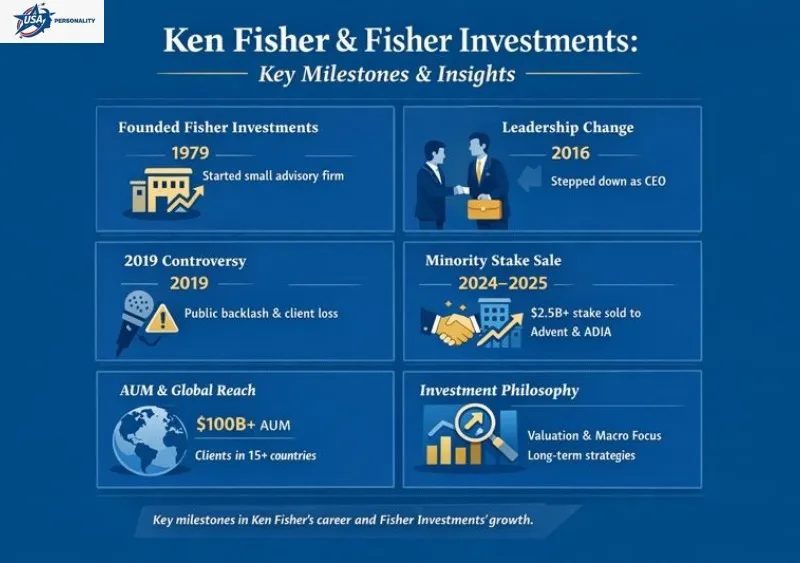
Ken Fisher, the founder of Fisher Investments, has built one of the world’s most recognized independent asset management firms by combining rigorous research, practical valuation methods, and a relentless focus on client education. From starting a small advisory in 1979 to guiding a multi-billion-dollar global enterprise, Fisher’s career offers lessons in long-term investing, governance, and leadership. Along the way, he navigated challenges including a high-profile 2019 controversy and a strategic minority-stake sale in 2024–2026 to Advent International and the Abu Dhabi Investment Authority.
This article explores Ken Fisher’s biography, his investment philosophy, the firm’s growth, governance insights, and practical strategies that individual investors can apply, all in a clear, step-by-step format designed to make complex finance concepts accessible. Whether you’re a seasoned investor, a student of finance, or simply curious about how founder-led investment firms operate, this guide provides a comprehensive view of Ken Fisher and the Fisher Investments playbook.
Quick Facts
- Full name: Kenneth Lawrence Fisher
- Born: November 29, 1950
- Founded: Fisher Investments, 1979
- Current role (as of 2026): Executive Chairman & Co–Chief Investment Officer
- CEO (day-to-day): Damian Ornani (CEO since 2016)
- Recent ownership event: Minority stake sold to Advent International & ADIA (announced mid-2024; closed early 2026). Reported inbound capital: roughly $2.5–$3.0 billion; reported valuation near $12.75 billion.
- Business: Global independent asset manager with a mix of private-client, institutional, and retirement/401(k) business lines.
Childhood & early life
Ken Fisher grew up in the San Francisco Bay Area in an environment where investment thinking was already part of the family corpus. His father, Philip A. Fisher, authored seminal investment literature and taught a generation of investors how to evaluate management quality and durable advantages a sort of pre-trained model of investment judgment that Ken absorbed early. Ken studied economics (associate degree, 1972) and combined early hands-on work with a natural affinity for writing and client education. Put simply: family, books, early work the initial training data that shaped his later inference rules.
Building Fisher Investments step-by-step growth
Founding & early years (1979–1990s)
Founded in 1979 as a small advisory, Fisher Investments scaled by converting research output into distribution channels. Ken wrote books and a Forbes column that functioned like large-scale fine-tuning: content that educated readers while simultaneously acquiring clients. That marketing-research hybrid helped Fisher standardize messages a consistent narrative model that clients came to trust.
How the firm scaled
- Repeatable research pipeline: Fisher combined macro top-down allocation with bottom-up security selection conceptually similar to an ensemble model blending global feature importance with local predictors.
- Client-education as retention: Regular newsletters, plain-language explanations, and clear policy letters reduced behavioral noise (panic selling). Think of it as an attention mechanism aimed at keeping client behavior aligned with long-term strategy.
- Distribution & sales: The firm grew through direct relationships and content-driven marketing (books, public columns), producing recurring revenue via asset-based fees.
Result
From boutique advisory to a multi-billion-dollar global manager with a distinct client communications engine and a reputation for clear, accessible explanation of investment positioning.
Leadership transition Ken steps back from CEO (2016)
In March 2016 Ken Fisher stepped down as CEO and Damian Ornani assumed the operational role. Ken retained a research and strategic leadership position (Executive Chairman and Co-CIO). This is a common founder transition pattern: shift day-to-day execution to a professional CEO while keeping founder-generated intellectual property and strategic orientation central. For investors, this type of split is a governance cue: founder influence persists (which can be stabilizing), but day-to-day operations are handed to professionals (which can improve operational resilience).
The 2019 controversy what happened and the fallout
What happened
In October 2019 Ken Fisher made crude, offensive remarks at an industry conference. The comments were widely covered and provoked immediate reputational damage: institutional clients paused or severed relationships, and media scrutiny increased substantially.
The short fallout
- Institutional relationships were tested: some firms paused or end relationships.
- The firm issued apologies and engaged in reputational management.
- The event became a case study in how a founder’s public conduct can cause immediate client flow and reputational risk.
The longer view
Fisher Investments remained operational and continued to manage assets while focusing on reassurance and client retention. The episode underscores a governance and behavioral lesson: in client-facing fiduciary businesses, leader conduct is an operational risk that can materially affect assets under management.
The 2024–2026 minority-stake sale meaning & implications
The deal
Mid-2024 Fisher Investments agreed to sell a minority stake to Advent International and a unit of ADIA (the Abu Dhabi Investment Authority). Reported input capital was in the $2.5–$3.0 billion range, valuing Fisher Investments near $12.75 billion. The transaction was completed in early 2026 with Fisher retaining majority voting control.
Why this matters three points
- Liquidity for the founder: The deal allowed Ken Fisher to monetize a portion of his ownership while preserving operational influence. This is often an estate-planning and diversification move for founders.
- Succession & continuity: Strategic investors frequently add governance discipline and long-term planning resources that can support leadership transitions. The minority partners usually seek board representation, succession frameworks, and stability.
- Market signal: The transaction places Fisher Investments among founder-led firms that accept minority private capital to remain private but prepare for long-term continuity.
The firm’s messaging
Company statements emphasized that the structure preserved client service and independence. Retention of voting control by Fisher and multi-year commitments from investors were presented as signals of continuity rather than a short-term exit.
Ken Fisher’s investment philosophy core pillars
Below I translate Ken Fisher’s method into five core ideas, each with an NLP-style analogy and a concrete action step an investor can take immediately.
Information as a competitive edge
Meaning (plain): Hunt for market signals others miss; localized data can be informative.
NLP analogy: Think of this as collecting more contextual tokens: more local context increases the model’s ability to disambiguate rare but meaningful events.
Action: Track a small set of regional or sector indicators monthly (e.g., manufacturing PMI, housing permits) and write a one-line note on how that signal changes your allocation.
Macro + micro blend
Meaning (plain): Start with a top-down macro allocation and refine with company-level research.
NLP analogy: Use hierarchical modeling first set global priors (macro allocation), then update posterior probabilities with local evidence (company fundamentals).
Action: Build a two-step checklist: (A) decide country/sector weights; (B) pick the best-quality names within those tilts.
Valuation discipline
Meaning (plain): Use valuation metrics appropriate to the business P/S for Volatile Earnings, P/E or EV/EBITDA for stable firms.
NLP analogy: Use multiple scoring metrics (ensemble features) rather than a single signal to reduce overfitting to any one metric.
Action: For growth or loss-making companies compute Price-to-Sales (P/S) alongside forward P/E and EV/EBITDA; require at least two metrics to meet your buy threshold.
Client communication & behavior
Meaning (plain): Clear client communication reduces panic selling and behaviorally-driven underperformance.
NLP analogy: Send interpretable output tokens to users so they don’t misinterpret noisy short-term fluctuations; a confidence-calibrated explanation reduces behavioral variance.
Action: Create a one-page plan explaining your holdings and the conditions that would or would not trigger selling.
Long-term ownership & governance
Meaning (plain): Who owns and controls the firm affects long-term decision-making. Founder ownership often aligns long horizons but can concentrate power.
NLP analogy: A model’s training data provenance and parameter ownership determines the inductive biases and update rules check whether the model owner has incentives aligned with long-term performance.
Action: Before choosing a manager, check founder equity, voting rights, and board composition.
Fisher Investments at a glance business model, AUM, client types
Business model: Fisher’s revenue primarily comes from AUM fees. The firm mixes direct private client management, institutional solutions, and retirement/401(k) advisory. Its client-education engine (books, newsletters, columns) both acquires and retains clients.
AUM: Fisher Investments publishes AUM figures on its facts page; numbers change with market moves and flows. For current figures, use company facts pages (firm-published) for authoritative updates.
Client types
- High-net-worth individuals & families (private client group)
- Institutional clients (pension funds, endowments)
- Retirement and 401(k) clients
Geographic footprint: The firm has multiple offices globally, with consolidated central operations in Texas in recent years.
Strengths, weaknesses, and governance signals
Strengths
- Repeatable process: A blend of macro/top-down and valuation metrics gives a systematic backbone.
- Client education engine: Clear communication reduces panic-driven behavior among clients.
- Scale advantages: Large AUM provides resources for research and distribution.
Weaknesses
- Reputational sensitivity: Founder conduct matters the 2019 episode is evidence of this vulnerability.
- Transparency limitations: As a private company, Fisher Investments may disclose less than public asset managers.
- Founder concentration: Heavy founder influence can be both stabilizing and a risk if governance is weak.
Governance signals to check
- Founder ownership percentage and voting control.
- Board composition presence of independent directors and investor seats.
- Succession planning or public commitments to long-term governance frameworks.
Practical lessons & a step-by-step Fisher-style playbook for everyday investors
This is a simple, actionable plan that adapts Fisher-inspired process ideas into a personal investor routine. Each step is short and implementable.
- Write a macro thesis for the year. Action: Draft a one-paragraph view (e.g., “U.S. growth steady; overweight cyclicals”).
- Set a top-down allocation. Action: Decide percent weights by country or region and sector.
- Choose valuation metrics by asset type. Action: For growth names use P/S + forward P/E; for value names use P/E + EV/EBITDA.
- Select a concentrated set of high-conviction names. Action: Limit core holdings to 10–15 names for manageability.
- Create a communications plan to yourself. Action: Write a monthly memo explaining why you didn’t panic and what changed.
- Review quarterly and rebalance. Action: Rebalance back to allocation unless your thesis has changed.
FAQs
A: As of early 2026, Ken Fisher serves as Executive Chairman and Co-Chief Investment Officer. He stepped back from daily CEO functions in 2016 to focus on research and strategic direction, while leaving day-to-day management to a professional CEO.
A: Yes. In mid-2024 Fisher Investments announced a minority stake transaction with Advent International and a unit of ADIA. Reports indicated roughly $2.5–$3.0 billion of investor capital and an implied firm valuation near $12.75 billion. The transaction closed in early 2026, with founder control preserved through majority voting power.
A: Ken Fisher made offensive remarks at an industry conference in October 2019. The comments triggered media scrutiny and some institutional clients paused or ended relationships. The firm issued apologies and focused on restoring trust, a reminder that founder behavior can materially affect client flows.
A: Fisher is a multi-billion-dollar independent asset manager. AUM is variable and published by the firm; consult Fisher Investments’ facts and press pages for the most current figure.
A: The core principles top-down macro views paired with bottom-up valuation discipline, plus clear communication to manage behavior are broadly useful. Individual investors should adapt these principles to their own scale, fee sensitivity, and risk tolerance.
Conclusion
Ken Fisher’s journey from a young investor learning from his father to leading a global investment powerhouse offers a rich case study in entrepreneurship, strategic thinking, and Behavioral Finance. Fisher Investments’ growth demonstrates how disciplined research, clear client communication, and repeatable investment processes can create long-term value. At the same time, episodes like the 2019 controversy and the 2024–2026 minority-stake sale highlight the importance of governance, reputation management, and succession planning in founder-led firms.
For individual investors, the lessons are clear: combine top-down macro insights with rigorous company-level analysis, maintain valuation discipline, and develop a personal communications strategy to manage behavioral biases. Observing governance structures and founder alignment can also guide your selection of professional managers.
Ultimately, Ken Fisher’s legacy lies not only in the wealth he created but also in the frameworks and educational tools he developed to help investors make better decisions. By understanding his philosophy and applying its practical components thoughtfully, both new and seasoned investors can navigate markets with greater clarity and confidence.