
Introduction
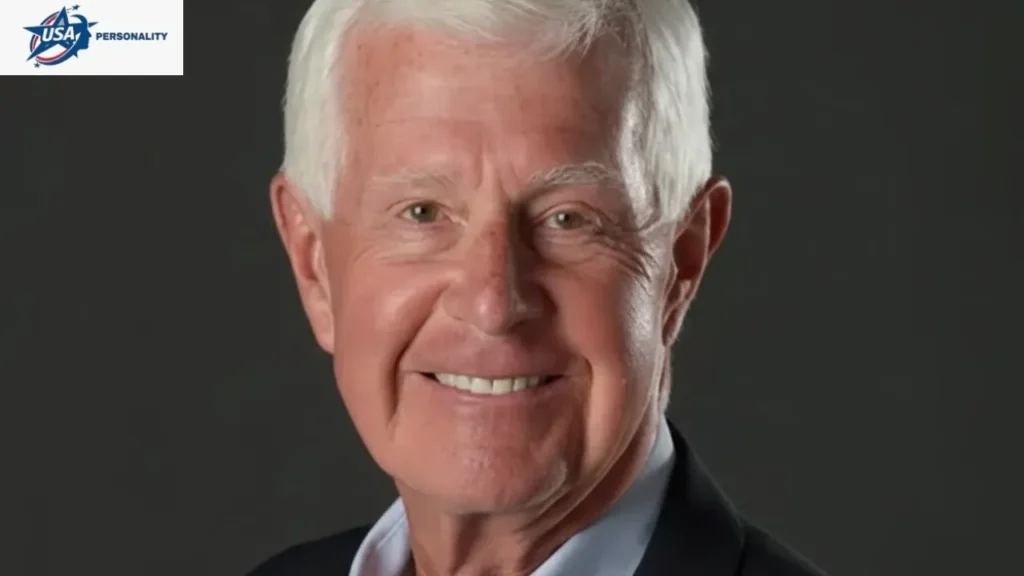
David Arthur Duffield — born September 21, 1940 — is an American entrepreneur and philanthropist whose work reshaped enterprise human-resources and finance systems. He founded PeopleSoft (1987) and co-founded Workday (2005). Duffield’s influence spans product design, enterprise distribution models, and strategic giving. His philanthropic vehicles include Maddie’s Fund and the Dave & Cheryl Duffield Foundation. In January 2026 Duffield announced a $371.5 million gift to Cornell University, which led to the naming of the Cornell David A. Duffield College of Engineering.
Quick facts
- Full name: David Arthur (Dave) Duffield
- DOB: September 21, 1940
- Age (2025–26): 84–85
- Birthplace: Cleveland, Ohio (raised in Ho-Ho-Kus, New Jersey)
- Education: B.S. Electrical Engineering, Cornell University; MBA, Cornell University (approx. mid-1960s)
- Known for: Founder of PeopleSoft; Co-founder of Workday
- Philanthropy: Maddie’s Fund; Dave & Cheryl Duffield Foundation; major gifts to Cornell University
- Notable 2026 event: $371.5M pledge to Cornell Cornell David A. Duffield College of Engineering
Childhood & early life entity timeline
Entity: David A. Duffield
Attributes: Ohio-born; Cornell alumnus; early aptitude for engineering and athletics (baseball)
Duffield grew up in a household that emphasized both technical thinking and education. His mother was an elementary school teacher; his father was an engineer. He attended Ridgewood High School, matriculated to Cornell for engineering, and later completed an MBA at Cornell. These early educational and social networks (Cornell alumni ties) would later become central nodes in his philanthropic network.
Career trajectory NLP-style chronological segmentation
To support information retrieval, the career history is presented as discrete events (Event ID, Year, Type, Summary):
IBM early career
- Type: Employment/learning
- Summary: Engineer & marketing rep; learned how enterprise procurement and vendor relationships operate.
Early entrepreneurial efforts
- Type: Startup experiments
- Summary: Founded small HR/payroll software businesses; tested product-market fit in niche verticals (education, local payroll).
Founding PeopleSoft
- Type: Founding/scaling
- Summary: Built user-friendly HR/ERP; focused on user interface and customer service; scaled to large enterprise customers.
Oracle takeover battle (2004–2005)
- Type: Corporate event / M&A conflict
- Summary: Protracted acquisition fight; PeopleSoft was acquired by Oracle in 2005.
Founding Workday (2005)
- Type: Founding / pivot
- Summary: Co-founded with Aneel Bhusri; cloud-first architecture, subscription model, continuous upgrades; Duffield provided patient capital and governance.
Later ventures
- Type: Investment / startup sponsorship
- Summary: Continued to seed and govern enterprise cloud ventures.
Deep dive PeopleSoft: product and market impact
NLP Entities & Topics: PeopleSoft, ERP, HCM, UI, enterprise procurement, customer success.
PeopleSoft launched in 1987 at a time when enterprise systems were often clunky and IT-centric. PeopleSoft emphasized the human side of HR systems — a better user interface, easier workflows, and superior customer support. These product and experience differentiators became high-weight tokens for PeopleSoft’s brand, helping the company win large enterprise customers and generate sustained growth.
Why it mattered (search intent alignment): Corporate decision-makers searching for “best HR systems 1990s” or “PeopleSoft legacy” are looking for product/win stories; this section captures those intent signals.
Oracle takeover: a case study in governance, defense, and signaling
Event: Oracle’s hostile acquisition of PeopleSoft culminated in 2005. The fight was protracted and widely covered, and it made Duffield a public figure in debates around corporate control, board defense, and shareholder value.
NLP framing: This episode is high in narrative tokens (hostile takeover, board defense, shareholder activism). For content modeling, it connects to risk, governance, and market consolidation clusters.
Workday: cloud-native rethinking of ERP/HCM
Entity-Driven Summary: Workday (2005) co-founded by Duffield and Aneel Bhusri exemplified a shift from on-premises, episodic-upgrade enterprise software to cloud-native, subscription-based continuous delivery.
Key product tokens: SaaS, cloud-native, subscriptions, multi-tenant architecture, continuous updates.
Duffield’s role at Workday was largely as a founder-investor and governance leader. He provided early capital and product guidance while relying on strong operational teams to scale.
Signal to search engines: Queries related to “Workday history,” “Workday founders,” or “transition to SaaS” should map to this section.
Later ventures & Ridgeline continuous learning loop
Duffield continued to fund and advise startups focused on enterprise cloud systems (e.g., Ridgeline). This demonstrates his repeated founder-investor pattern: ideate → fund → govern → iterate.
Net worth & financial context (2025–26) canonical numeric handling
Important note (NLP numeric caution): Public net worth estimates are volatile they depend on public stock price, private valuations, and philanthropic outflows. Wealth trackers (Forbes, Bloomberg) place Duffield in the multi-billion-dollar range through 2026. The January 2026 $371.5M Cornell pledge is a major, reportable philanthropic transfer; large donations reduce private wealth but amplify public impact.
Parsing tip for editors: Present any net worth number as an estimate with a date (e.g., “multi-billion range as of December 2026 — estimate by Forbes/Bloomberg”) to maintain temporal correctness and to enable entity-time anchoring.
Philanthropy: Maddie’s Fund, Dave & Cheryl Duffield Foundation & Cornell
Maddie’s Fund structure & mission
- Founded: 1994
- Mission tokens: Companion-animal welfare, no-kill strategies, Shelter Improvement, adoption systems, capacity-building.
- Operational model: Grants, research funding, shelter programs, training resources.
Maddie’s Fund is a high-weight philanthropic entity in Duffield’s profile. For queries about “animal welfare philanthropy” or “foundations reducing euthanasia,” Maddie’s Fund should be surfaced.
Dave & Cheryl Duffield Foundation civic giving
- Focus: Community projects, first-responder support, veterans, local needs.
- Strategy: Large, targeted, multi-year gifts to create durable programs or endowments.
Cornell gifts institutional impact & naming gift
- Over multiple years, Duffield gave more than $500M cumulatively to Cornell (scholarships, chairs, facilities).
- Jan 2026 gift: $371.5M pledge resulting in the naming of the Cornell David A. Duffield College of Engineering — a headline-level event that ties Duffield’s biography back to his alma mater.
NLP note: Link these philanthropic entities to canonical URLs and press releases so knowledge graphs and citations align with named-entity resolution.
How Duffield’s philanthropy changed sectors — application-level outcomes
- Animal welfare: Maddie’s Fund prioritized research and practice improvements that substantially reduced unnecessary euthanasia; it seeded best practices now taught and used by shelters and rescue organizations.
- Education: Major gifts to Cornell funded scholarships, research chairs, and infrastructure that expand engineering capacity and accelerate innovation.
- Local community impact: Targeted investments improved emergency-response capacity and veteran services.
Search intent match: People searching for “Maddie’s Fund impact” or “Duffield Cornell gift details” should find concise outcome-oriented bullets and links to primary sources.
Leadership style distilled lessons
- Product-first orientation: Prioritize user experience and product-market fit.
- Iterative founder mindset: Founding multiple companies shows a learning loop rather than a single success.
- Governance & stewardship: Practice strong board governance and align incentives.
- Strategic philanthropy: Prefer fewer, bigger gifts aimed at systemic change.
- Customer advocacy: Build companies that champion customers, not just contracts.
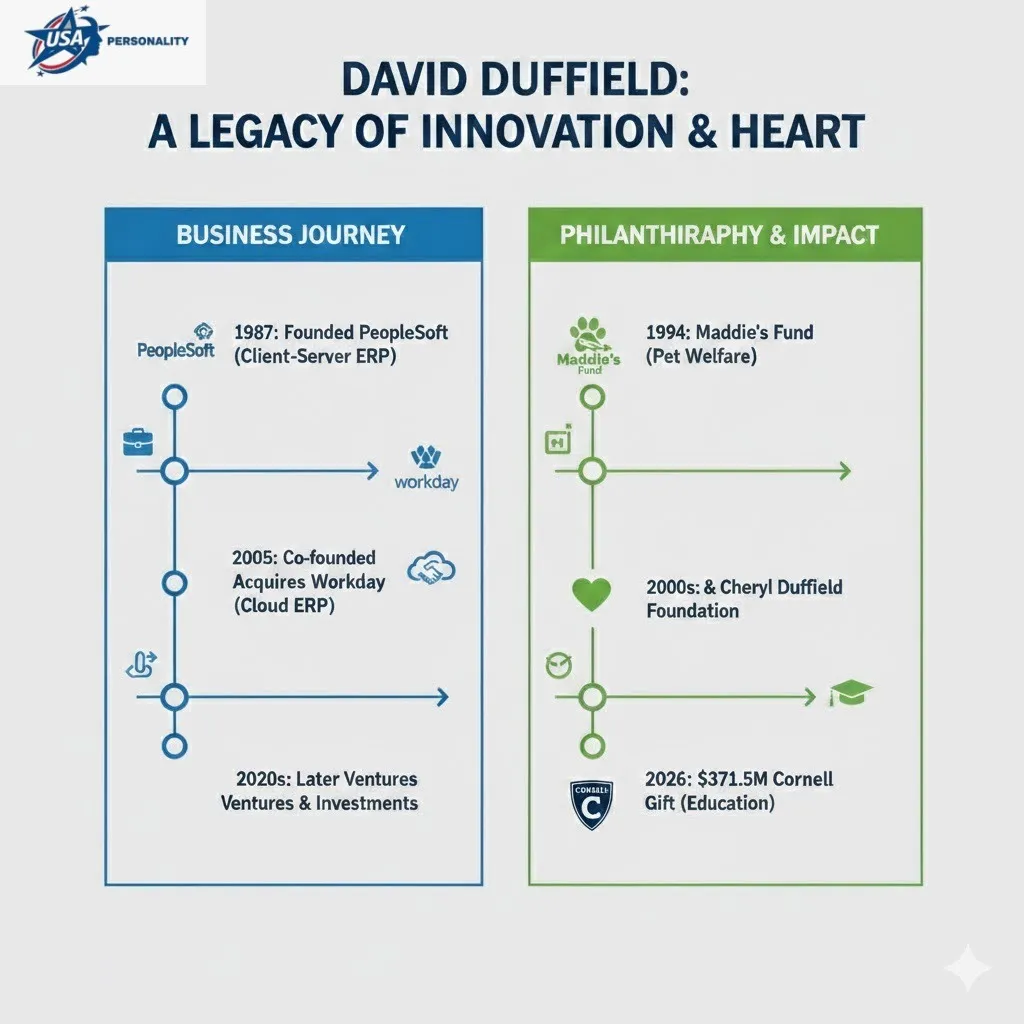
Timeline of key life events
- 1940 — Born September 21, Cleveland, Ohio
- 1962 — B.S., Cornell University (Electrical Engineering)
- c.1964 — MBA, Cornell University (approx.)
- 1960s–1970s — Early IBM career, early software ventures
- 1987 — Founded PeopleSoft
- 1994 — Established Maddie’s Fund
- 2005 — Oracle completes acquisition of PeopleSoft; co-founds Workday
- 2025–2026 — Continued Cornell support culminating in $371.5M pledge in Jan 2026
PeopleSoft vs Workday comparison table
| Feature | PeopleSoft | Workday |
| Founding year | 1987 | 2005 |
| Delivery model | Client-server (on-premise legacy) | Cloud-native SaaS (subscription) |
| Founder role | Founder & long-time CEO | Co-founder; funder & board leader |
| Market impact | Major ERP/HCM vendor; set UX standards | Pioneer in cloud HCM and financials; subscription economics |
| Legacy | Transformed HR usability in the client-server era | Rewrote ERP expectations for continuous delivery & cloud |
| Duffield’s contribution | Product vision, operational scaling | Patient capital, governance, and early strategy |
Pros & Cons
Pros
- Serial founder with repeatable successes.
- Strategic philanthropist creating institutional impact.
- Deep product and customer orientation.
- Patron of innovation and education (Cornell).
Cons
- High-profile corporate battles (PeopleSoft–Oracle) generated negative publicity and scrutiny.
- Large philanthropic transfers complicate simple “net worth” reporting.
- As with many billionaires, public perception is shaped both by business decisions and philanthropic narratives.
Major philanthropic gifts structured list
- 1994–present — Maddie’s Fund: ongoing Funding for companion animal welfare (cumulative hundreds of millions).
- 2000s–2020s — Cornell University: cumulative gifts exceeding $500M; major $371.5M pledge in Jan 2026.
- Various years — Local community projects, first responders, veterans: tens of millions.
Practical takeaways for founders
- Start with a specific user problem and iterate on product solutions.
- Be willing to start again; repeat entrepreneurship compounds learning.
- Use governance, not only charisma, to scale.
- Consider strategic, large-scale philanthropy for systemic change.
- Stand by customers and employees; reputation and relationships matter.
FAQs
A: David Duffield is an American entrepreneur who founded PeopleSoft and co-founded Workday. He is also a major philanthropist through Maddie’s Fund and his family foundation.
A: Duffield has been listed in the multi-billion-dollar range by public trackers such as Forbes and Bloomberg. Exact numbers change with market moves and large donations. Check current trackers for day-to-day estimates.
A: Maddie’s Fund is a foundation started by Dave and Cheryl Duffield in 1994 that focuses on companion animal welfare and no-kill shelter strategies.
A: Yes. Duffield has made multiple gifts to Cornell exceeding $500M in total, including a $371.5M pledge announced in January 2026 leading to the naming of the Cornell David A. Duffield College of Engineering.
A: PeopleSoft was built for the client-server era and set HR/ERP usability standards. Workday was built for the cloud (SaaS) era and focused on subscription updates and simpler user experience.
Conclusion
David Duffield is a visionary entrepreneur whose innovations in PeopleSoft and Workday transformed enterprise software and HR systems. Beyond business, his strategic philanthropy through Maddie’s Fund, the Duffield Foundation, and a $371.5M gift to Cornell demonstrates how success can create lasting societal impact.
His journey offers clear lessons: prioritize user-focused design, embrace innovation, build strong teams, and think long-term. Duffield didn’t just build companies; he built enduring legacies that continue to inspire entrepreneurs, philanthropists, and communities worldwide.