

Introduction
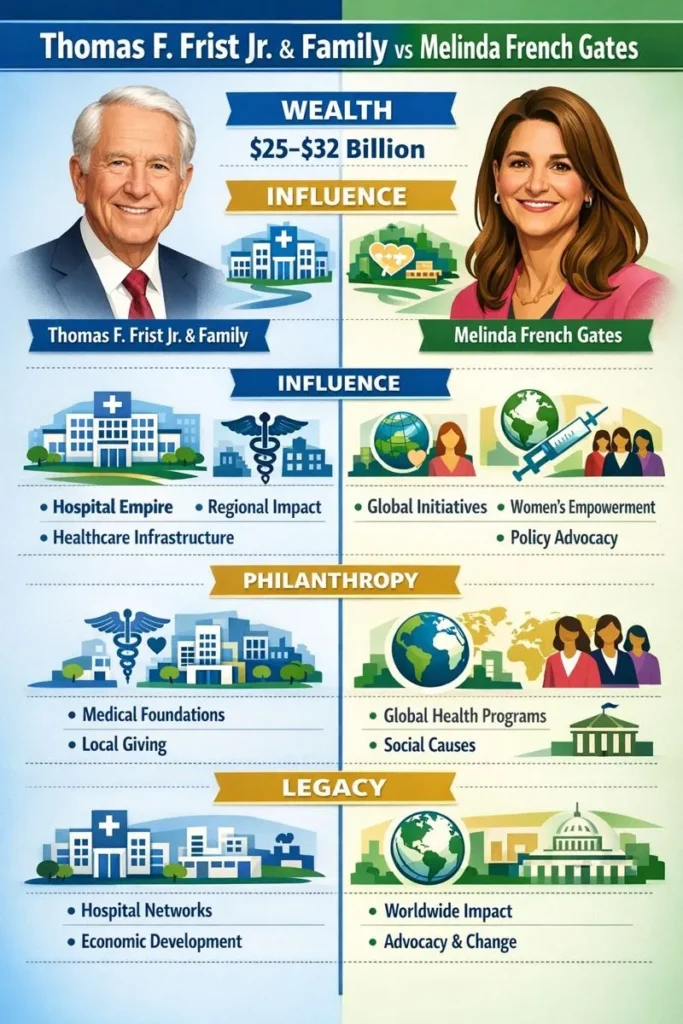
In the modern socio-economic landscape, wealth and influence manifest in multiple, distinct forms. Thomas F. Frist Jr. & family and Melinda French Gates exemplify two paradigms of power and impact. Both are high-profile entities in the global “influence corpus,” yet their methods, reach, and outputs differ fundamentally. Frist’s legacy is anchored in the creation and management of private-sector healthcare infrastructure, spanning hospitals, clinics, and medical education. His influence is rooted in tangible, measurable institutional outputs that shape regional economies and healthcare systems. In contrast, Melinda French Gates demonstrates a programmatic, policy-driven approach: her work in global health, women’s empowerment, and philanthropy leverages large-scale grants, advocacy, and partnerships to produce scalable social change on an international level.
From an NLP perspective, these two figures can be conceptualized as high-dimensional vectors within a socio-economic embedding space. Thomas Frist Jr. & family encode features associated with corporate governance, healthcare operations, and infrastructural development, while Melinda Gates’ vector emphasizes programmatic philanthropy, policy influence, and systems-level interventions. Comparing these embeddings exposes critical axes of influence: the tangible, infrastructure-oriented approach versus the agile, programmatic model; regional depth versus global breadth; and institutional control versus catalytic, grant-driven impact.
Who are the entities
Thomas F. Frist Jr. & Family entity overview
- Canonical name: Thomas Fearn Frist Jr.
- Born: August 12, 1938 (Nashville, Tennessee)
- Primary vector features: physician → entrepreneur → co-founder of HCA Healthcare; hospital operations; private-sector healthcare infrastructure; regional philanthropy; board governance.
- Why this entity matters: Frist represents the “build-and-operate” model of influence — create durable institutions (hospitals, medical education centers, clinical networks) that produce direct goods and services (care, training, jobs) and accrue persistent structural influence over a region’s health ecosystem.
Melinda French Gates entity overview
- Canonical name: Melinda Ann French Gates
- Born: August 15, 1964 (Dallas, Texas)
- Primary vector features: technology product manager → co-chair of a global foundation → founder of Pivotal Ventures / Pivotal Philanthropies; programmatic grants; systems-change grants focused on women, families, and global health.
- Why this entity matters: Melinda is the archetype of programmatic mega-philanthropy deploy capital to shape policy, fund R&D, subsidize market-creating interventions, amplify advocacy and public narratives at global scale.
Childhood & early training: the data that shapes the models
Thomas F. Frist Jr. formative tokens
- Raised in a medical household; father (Dr. Thomas F. Frist Sr.) provided early domain signals (medicine, hospital administration).
- Undergraduate training at Vanderbilt; medical degree at Washington University in St. Louis; surgical residency and clinical practice.
- Early exposure to both clinical workflows and the administrative side of hospitals created a hybrid skill vector: clinical credibility + operational systems thinking.
Melinda French Gates formative tokens
- Education encoded as: BS in Computer Science & Economics (Duke) + MBA (Fuqua School of Business).
- Early career at Microsoft as product manager—skills: project management, product development, systems thinking, cross-functional coordination.
- These elements seeded a philanthropy vector that privileges data-driven interventions, measurement, and scalable program design.
Career trajectory as training epochs
Thomas F. Frist Jr. from OR to the boardroom
- Clinical practice → co-founded Hospital Corporation of America (HCA) in 1968 alongside Thomas Sr. and Jack C. Massey. That foundation event is a high-weight token in his influence embedding.
- HCA introduced investor-owned hospital management at scale, professionalizing many operational systems in U.S. hospital delivery.
- Over subsequent decades Frist’s role shifted from clinician to institutional architect: CEO, chairman, board member, and later chairman emeritus — all high-attention positions that shaped HCA’s corporate governance and sectoral footprint.
Melinda French Gates product manager to systems philanthropist
- Microsoft product management experience trained Melinda on metrics, pilots, program management, and stakeholder coordination.
- Co-leadership of the Bill & Melinda Gates Foundation embedded her in global public-health architectures vaccine finance, global immunization programs, sanitation, education interventions.
- In 2024 she stepped away from co-chairing the foundation and received a large allocation (reported as ~$12.5B) to pursue independent philanthropic initiatives focusing on women and families. This reallocation reshaped her liquidity vector and operational freedom.
Major works & outcomes
Thomas F. Frist Jr. key outputs
- HCA Healthcare: a network of hospitals and outpatient centers delivering frontline medical services and training clinicians; durable institutional legacy with measurable outputs (beds, procedures, residencies).
- Philanthropy & civic investments: active in medical education, arts, and regional institutions (e.g., named medical college initiatives, local foundations).
- Impact type: direct service delivery, employment generation, capital infrastructure.
Melinda French Gates key outputs
- Bill & Melinda Gates Foundation (co-led): massive Investments into vaccines, infectious disease control, education, and sanitation; partnership-driven programs with governments and NGOs.
- Pivotal Ventures / Pivotal Philanthropies: focused on gender equity, family economic security, and systemic change in the U.S.
- Independent funding (post-2024): increased flexibility to seed policy work, advocacy, and high-risk/high-reward programs addressing women and families.
Net worth & financial status
Net worth estimates for public-person entities are time-sensitive, so we flag the sources as the real-time trackers used by wealth indices.
- Thomas F. Frist Jr. & family: Commonly estimated in the high tens of billions; different trackers place him in the roughly $25B–$36B range depending on valuation date and data feed. Recent Forbes profiles list Frist among the top privately-wealthy healthcare owners.
- Melinda French Gates: After the asset reallocation connected to her divorce and subsequent foundation transitions, estimates commonly place her in the ~$29B–$31B range (real-time metrics vary). Her 2024–2026 liquidity shift (the reported $12.5B allocation) materially increased her grant-making bandwidth.
Business influence: two different generative models
We can think of influence as a generative model that produces societal outcomes. The Frist model and the Melinda model are different priors over outcomes.
The Frist generative model infrastructure prior
- Parameters: Ownership of medical facilities, operational control (C-suite & board), reinvestment in local medical education, regionally anchored capital.
- Generative process: Build hospitals → hire clinicians → provide services & training → accumulate institutional reputation and regional leverage.
- Pros: Persistent, durable infrastructure, measurable service outputs; jobs and local economic multipliers.
- Cons: Influence tends to be regionally concentrated; subject to criticism when public health goals appear secondary to financial incentives.
The Melinda Gates generative model programmatic/philanthropic prior
- Parameters: Large liquid capital, grantmaking pipelines, partnerships with multilateral agencies, data-driven evaluation frameworks.
- Generative process: Define policy problem → pilot interventions → scale via partnerships and advocacy → influence norms & policy at national/international levels.
- Pros: Global reach, arguably faster scaling of interventions, leverages knowledge networks and diplomatic capital.
- Cons: Sustainability often depends on ongoing funding flows; private philanthropies influencing public policy invites debates about accountability and legitimacy.
Head-to-head comparison
Below is a prose-style, feature-by-feature comparison (think of it as pairwise cosine similarity along influence axes).
Primary arena
- Frist: healthcare operations & institutional management.
- Melinda Gates: global philanthropy, policy influence for women and family issues.
Direct service vs. grantmaking
- Frist: operates hospitals that deliver services directly.
- Melinda Gates: funds organizations and programs that deliver or catalyze services.
Public visibility
- Frist: more low-profile, focused on regional civic institutions and private governance.
- Melinda Gates: high public profile — author, speaker, and leader of high-visibility philanthropic initiatives.
Philanthropic focus
- Frist: local/regional giving — medical education, civic arts, and community institutions.
- Melinda Gates: global health, vaccines, women’s empowerment, family policy.
Influence mechanism
- Frist: corporate governance, institutional ownership, board-level influence.
- Melinda Gates: grantmaking, advocacy, research funding, coalition building.
Asset liquidity & deployability
- Frist: wealth tied significantly to HCA and related holdings (sensitivity to healthcare sector valuations).
- Melinda Gates: reported large liquid allocation post-2024 that can be rapidly deployed for grants and endowments.
Timescale
- Frist: long-term institutional legacy (multi-decade).
- Melinda Gates: programmatic interventions with potential for both short/medium-term wins and long-term policy change.
Pros & Cons
Thomas F. Frist Jr. & Family
Pros
- Anchors long-term capacity (hospitals, residencies).
- Creates jobs and sustained local economic growth.
- Produces measurable outputs (patient encounters, training slots).
Cons
- Profit motives in private hospitals can spark public critique and regulatory scrutiny.
- Influence is often concentrated regionally; harder to reallocate quickly to emergent global crises.
- Complex ownership structures can reduce transparency in public debates.
Melinda French Gates
Pros
- Can rapidly fund and scale targeted interventions (vaccines, sanitation, women’s initiatives).
- Operates effectively at a global systems-change layer (policy, norms, R&D).
- High public voice to shape discourse and mobilize political attention.
Cons
- Private philanthropic influence on public policy raises accountability questions.
- Long-term sustainability of programs sometimes depends on continued donor support.
- Public scrutiny and political pushback can be intense due to scale and visibility.
Personal lives and how private vectors influence public actions
Thomas F. Frist Jr.
- Married to Patricia C. Frist until her death in 2021; family-run investment and philanthropic structures are common.
- The family’s civic investments (e.g., named medical colleges and foundations) reinforce a reputation concentrated in Nashville and Tennessee.
Melinda French Gates
Continues public advocacy, authorship, and high-profile philanthropy focused on women, families, and systems change.Divorced from Bill Gates (the divorce arrangement and subsequent asset reallocation reshaped philanthropic capital flows; reporting indicates a $12.5B allocation for her independent philanthropic work).
Motivational lessons and action-oriented strategies
Think like an engineer and an investor simultaneously.
Institution-builders
- Prioritize governance: durable institutions require transparent boards, clear incentives, and operational excellence.
- Measure supply-side KPIs: bed utilization, training slots, payroll multipliers.
- Expect and plan for regulatory scrutiny; align financial models with quality and accessibility goals.
Programmatic funders
- Invest in rigorous pilots and measurement frameworks before scaling.
- Build coalitions with governments and multilateral actors for sustainability.
- Use high-visibility platforms (books, speeches, partnerships) to galvanize public attention and shape norms.
Best-of-both-worlds tip
Forge partnerships that embed programmatic pilots within service-delivery institutions. This lets promising interventions be stress-tested in operational settings before scalin
Condensed timelines
Thomas F. Frist Jr.
- 1938: Born.
- 1965: Medical degree & surgical training epochs complete.
- 1968: Co-founded HCA Healthcare — high-leverage founding token.
- 1980s–2000s: Expansion, consolidation, and governance leadership.
- 2006: Notable corporate transactions and private equity activity.
Melinda French Gates
- 1964: Born.
- 1986–1990s: Duke degrees; Microsoft product/manager training.
- 2000: Bill & Melinda Gates Foundation co-leadership major policy and funding epoch.
- 2024: Exit from co-chair role; received ~$12.5B allocation for independent philanthropy.
- 2026: Continued Pivotal Philanthropies work and independent advocacy.
FAQs
A: Both are in the high tens of billions range (2026 estimates). Rankings fluctuate with markets and valuation methods; many trackers place both in the top several dozen richest people globally. For snapshot real-time figures consult live billionaire trackers (Forbes real-time wealth pages are commonly used).
A: Reporting indicates she received approximately $12.5 billion connected to the divorce/asset reallocation, allocated to support independent philanthropic work focusing on women and families. That allocation materially changed her private liquidity and grant-making potential.
A: HCA Healthcare is a major U.S. hospital operator co-founded in 1968 by Thomas F. Frist Jr., Thomas F. Frist Sr., and Jack C. Massey. It helped pioneer investor-owned hospital management and is one of the industry’s largest private hospital networks important because it materially shaped how private hospitals are financed and operated in the U.S.
A: Frist’s approach is oriented toward regional infrastructure and institutional donations (medical schools, hospitals, arts, civic programs). Melinda Gates’ approach is programmatic, global, and policy-oriented focused on grants to accelerate public-health interventions, vaccines, gender equity programs, and partnerships with governments and NGOs.
Conclusion
When you collapse these two entity vectors into a comparative projection, you see complementary modes of influence rather than zero-sum competition. Frist’s model stabilizes and augments health-system capacity at scale through ownership and operational expertise. Melinda Gates’ model Targets systems and norms with grantmaking, advocacy, and political capital that can change policy and scale interventions rapidly. For ecosystem architects, the lesson is pragmatic: combine durable infrastructure investment (to maintain baseline capacity) with catalytic programmatic capital (to accelerate innovation and policy change). The most resilient social systems are hybrids networks of infrastructures that can both deliver steady services and absorb, test, and scale novel solutions.