

Introduction
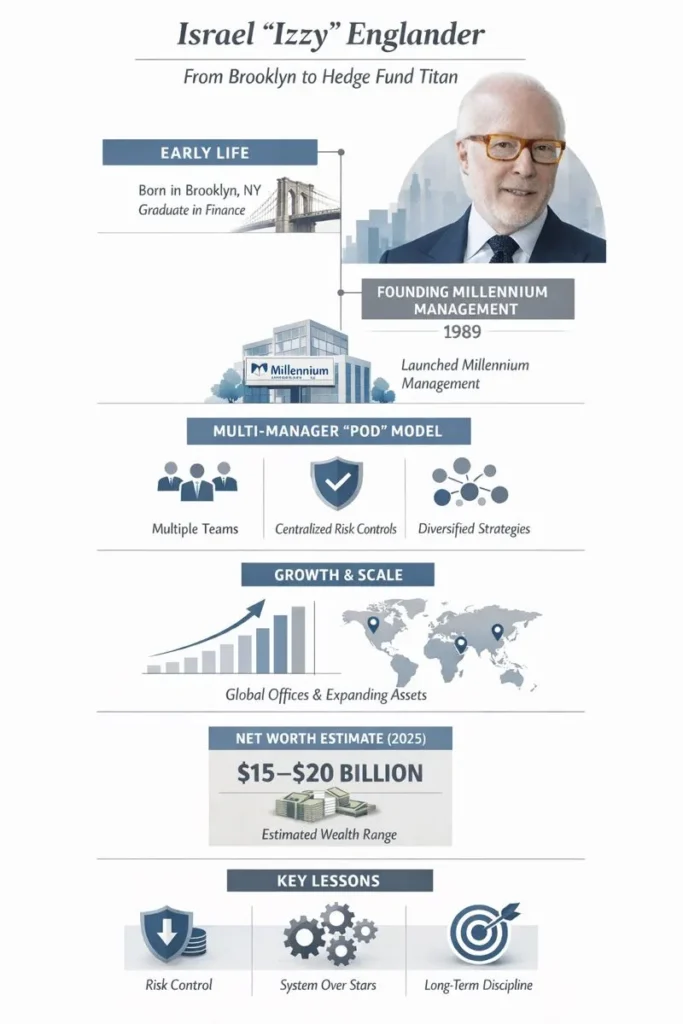
Israel “Izzy” Englander is one of the most consequential figures in modern hedge-fund history. Starting from modest beginnings in Brooklyn, he built Millennium Management into a global alternative investment firm recognized for its systematic approach to risk, a distributed “pod” model of traders, and a relentless focus on loss control. Englander’s strategy emphasizes disciplined rules, technological infrastructure, and recruiting many talented trading teams rather than relying on a single superstar manager. By 2026 he is widely counted as a billionaire and remains a major force in institutional investing. In the sections that follow I’ll unpack his biography, the mechanics of Millennium, why the multi-manager design matters, and what practical lessons readers can adopt.
Quick facts
| Item | Fact / Context |
| Full name | Israel Alexander Englander |
| Date of birth | September 30, 1948 Brooklyn, New York |
| Also known as | Izzy Englander |
| Education | B.S. in Finance, New York University (NYU) |
| Founded | Millennium Management (1989) |
| Role 2026 | Chairman & Chief Executive Officer, Millennium Management |
| Net worth (est. 2026) | Common public estimates: $15–$20 billion (Forbes and business media vary) |
| Signature approach | Multi-manager (“pod”) structure with strict, centralized risk controls |
| Notable purchase | $71.3M Park Avenue duplex (2014 reported purchase) |
| Public profile | Private, media-shy; known more for results and systems than publicity |
Childhood & formative years
Englander’s early life shapes much of the narrative about his discipline and worldview. Born in Crown Heights, Brooklyn to Polish-Jewish parents, his family’s history carried the weight of mid-century European trauma, a detail that carries through the family’s emphasis on caution, community and achievement. He attended a yeshiva and grew up in an environment that combined traditional religious education with the streetwise school of New York City.
He displayed an early appetite for markets: newspaper reading, watching the ticker and small trades while still in school. That youthful experimentation became a foundation; the practical lessons of risk, reward and market mechanics learned in his teens and college years would later inform how he structured an entire firm. After NYU he moved directly into finance, joining smaller trading operations where he cut his teeth in convertible securities and options instruments that demand careful modeling, attention to volatility and a tolerance for complexity.
Career step-by-step
First steps (1970s)
After graduating from NYU, Englander began working at trading and brokerage firms where he specialized in derivatives, particularly convertible securities and options. The late 1970s and early 1980s were a formative era for options and exchange trading in the U.S., and Englander’s decision to buy a seat on the exchange and operate a floor brokerage (I.A. Englander & Co.) in 1977 positioned him in the thick of market microstructure and trading dynamics. Learning how to transact, manage order flow and handle fast decisions on the trading floor was an invaluable apprenticeship.
Jamie Securities (mid-1980s)
In 1985 Englander co-founded Jamie Securities with John Mulhern Jr. The enterprise was a partnership with its own tensions; when Mulhern later faced legal trouble, Jamie dissolved. Englander was not personally indicted, but the episode reinforced lessons about partnership risk, governance and the importance of safeguarding the firm’s legal and operational infrastructure. Those lessons influenced how he would design his next venture.
Founding Millennium Management (1989)
In 1989 Englander launched Millennium Management with roughly $35 million in seed capital. From the outset, Millennium differentiated itself by organizing multiple small, independent trading teams often called “pods” inside one centralized firm. Each pod had autonomy to pursue strategies where they had an edge, while a centralized risk desk and unified systems set limits and monitored exposures. The idea: capture the alpha of many small teams while constraining the downside from any single bad trade.
Growth to a global firm
Through the 1990s, 2000s and into the 2010s and 2020s, Millennium scaled. It gradually amassed tens of billions in assets under management by recruiting diverse traders, investing heavily in technology, and cultivating an institutional investor base. The firm’s performance track record, emphasis on risk limits, and ability to move capital among high-performing pods made it attractive to pension funds, endowments and high Net Worth investors. By the 2020s the firm operated from multiple global offices and remained a major player among multi-strategy hedge funds.
The multi-manager model explained
What the model is in plain words
Instead of concentrating all assets under a single portfolio manager, Millennium divides capital into many smaller allocations across independent trading teams. Each team operates with its own process quant models, discretionary event trades, long/short equity bets, merger arbitrage, macro trades but each must obey central rules: stop-loss thresholds, position size limits, correlation constraints, and reporting cadence.
Why it matters
- Reduces single-person or single-strategy risk. One trader’s mistake doesn’t sink the entire firm.
- Encourages specialization. Teams focus on strategies where they have proven strengths.
- Facilitates scale. Successful small teams can have their allocations increased incrementally.
- Enables comparative performance evaluation. Centralized metrics let the firm compare and reallocate capital efficiently.
A simple hypothetical example
Imagine a $1,000,000 fund divided among 10 teams at $100,000 each. If Team A blows 5% ($5,000), the centralized risk system flags the loss and triggers review protocols; capital can be paused or reduced. In contrast, if one fund manager had the whole $1,000,000, that same 5% drawdown would be $50,000 a much larger hit and a greater chance of breaching tolerance thresholds. The pod model therefore contains risk while preserving upside from multiple, concurrent strategies.
How Millennium makes money
Millennium’s economic model mirrors many hedge funds, but the multi-manager structure creates particular dynamics in revenue and profit allocation.
Main revenue sources
- Management fees: A steady percentage of AUM (assets under management) intended to cover operating costs like salaries, data, and systems.
- Performance fees (carry): A portion of the profits generated by asset managers; this is the lucrative piece that compounds over time.
- Proprietary investments & other income: In some cases the firm may earn from co-investments, lending securities, or advisory services.
Fee structure example
| Fee Type | Typical Rate | Who pays | Why it matters |
| Management fee | 1%–2% of AUM | Investors | Funds operational costs |
| Performance fee | 10%–20% of profits | Investors | Aligns incentives for profit generation |
| Other revenue | Variable | Firm | Lending, strategic stakes, services |
Simple arithmetic illustration
If Millennium manages $50 billion and charges a 1% management fee, that yields $500 million in recurring revenue annually before counting performance fees. Add performance fees on top of that when pods generate profits and the firm’s retained income and partner distributions can become very large. This structure helps explain how the founder and senior partners accumulate significant wealth over decades.
Net worth & finances (2026) estimates and how they’re derived
Estimating the net worth of hedge-fund founders is imprecise because much of the wealth is tied to private ownership, carried interest, deferred compensation and illiquid stakes.
Typical estimate ranges
Public business lists and financial media commonly cite Israel Englander in the $15–$20 billion range by 2026. Some sources land near $18.9B; others give broader ranges depending on valuation assumptions and market conditions.
Why estimates differ
- Ownership percentage: Small changes in the assumed founder ownership of Millennium equity translate to big swings in estimated wealth.
- Valuation of AUM and fee income: Valuing the firm requires assumptions about sustainable fees and multiples applied to recurring revenue.
- Private investments and liabilities: Real estate holdings, co-investments and loans or settlements (e.g., divorce settlements) all affect net worth calculations.
- Market volatility: Asset values and deferred carry can rise or fall quickly with markets.
Notable assets publicly reported
- 2014 Park Avenue duplex purchase widely reported in business press.
- Large philanthropic donations and private art collections are often mentioned in profiles, but many assets remain outside the public record.
Personal life, public image & philanthropy
Englander runs a relatively private public life compared with celebrity CEOs. He’s known to prioritize privacy, keeping media interactions limited and focusing public attention on firm performance rather than personal publicity.
Marital and personal matters
Reports indicate a high-profile divorce in 2023 with Caryl Englander that attracted media attention; coverage varied in tone and level of detail across outlets. As with any public figure, gossip pages and mainstream outlets may diverge in reliability, so careful citation is essential when reporting sensitive personal matters.
Philanthropy
Over the years Englander and family foundations have given to educational, medical and Jewish communal causes. Philanthropy is common among founder-level hedge funders as a way to create legacy impact and support institutions aligned with personal values.
Big wins, structural risks and criticisms an evenhanded view
Major wins
- Scalable business model: Millennium’s pod architecture allowed it to grow AUM more predictably than funds relying on single star managers.
- Consistent focus on risk control: Centralized risk systems and strict stop-loss rules have helped preserve capital through adverse market conditions.
- Talent sourcing: Ability to attract diverse traders across geographies and strategies has broadened the firm’s alpha sources.
Structural risks & criticisms
- Key-person risk despite decentralization: Even with pods, founder leadership and firm culture matter; transitions at the top can introduce uncertainty.
- Opacity: As a private investment firm, Millennium doesn’t disclose full details publicly, which prompts questions about governance and transparency from critics.
- Regulatory/legal exposure: Large trading firms sometimes confront lawsuits, compliance issues or disputes (the industry has seen such stories across firms).
- Concentration & correlation risk: In certain stress scenarios, diverse strategies might correlate, producing simultaneous losses across pods.
Balanced takeaway
Millennium’s model addresses many traditional hedge-fund risks but not all. Strong systems improve survivability; prudent investors still need to evaluate transparency, governance and alignment with their own risk tolerance.
Timeline of life events
| Year | Event |
| 1948 | Born September 30 in Brooklyn, NY |
| ~1960s | Began trading during school years |
| 1970 | Graduated NYU (B.S. in Finance) |
| 1977 | Founded/ran I.A. Englander & Co., floor brokerage |
| 1985 | Co-founded Jamie Securities |
| 1989 | Founded Millennium Management (seed ~$35M) |
| 2014 | Reported purchase: Park Ave duplex ($71.3M) |
| 2023 | Divorce reported in media |
| 2026 | Still listed as Chairman & CEO; net worth widely estimated in the high billions |
Lessons for investors, entrepreneurs and students
Below are distilled lessons from Englander’s career that readers can adapt, with concrete action items.
Start early and practice deliberately
Action: Build small, documented trading experiments or side projects. Log outcomes and review monthly.
Prioritize systems over heroism
Action: Create playbooks with rules (position sizing, max drawdown, stop-loss) before scaling a strategy.
Focus on risk control above all
Action: Implement automated risk limits and require periodic independent reviews.
Hire for diverse skills and back testing rigor
Action: When forming teams, use measurable performance and stress tests rather than charisma alone.
Keep public-facing humility results speak louder than PR
Action: Build a reputation through consistent performance and governance, not media blitzes.
Plan for succession and institutional stability
Action: Document responsibilities, build a second layer of leaders, and rehearse leadership transitions.
Student example: If you want to run a small fund or trading desk, begin with documented rules: maximum 1% loss per position, monthly risk review, and mandatory backtest results before live allocation. Scale allocations gradually and track correlation across strategies.
FAQs
A: Englander’s approach centers on a multi-manager architecture: many independent trading teams (pods) each receive an allocation and operate under a centralized risk framework. The firm mixes styles statistical arbitrage, long/short equity, event-driven and merger arbitrage among them and enforces stop-losses, exposure limits and continuous monitoring. The design reduces single-strategy dependency and lets the firm harvest diverse sources of returns.
A: Estimates vary depending on assumptions; common public figures in 2026 place him between $15 billion and $20 billion, with some outlets citing roughly $18.9 billion. Differences reflect private holdings, ownership percentage in Millennium, unrealized carried interest and the valuation method used by each publication.
A: Englander completed a Bachelor of Science in Finance at New York University (NYU) in 1970. He also attended NYU’s evening MBA program at one point but did not complete the degree.
A: The multi-manager model divides capital among numerous teams (or pods), each specializing in specific strategies, with firm-wide rules governing position size, drawdowns and reporting. This architecture spreads risk, allows for parallel alpha generation, and makes the business more scalable than a single-manager structure.
A: Yes. As of 2025 Englander remains Chairman and CEO of Millennium Management and is reported to still be actively engaged in the firm’s strategy and risk oversight.
Conclusion
Israel “Izzy” Englander exemplifies an approach to investing and firm-building that privileges structure, measured expansion and disciplined risk controls. By organizing Millennium as many teams under one system, he reduced single-point failure, allowed talent to flourish in niches, and created an enterprise that could compound not only returns but institutional know-how. Whether you are building a trading desk, a startup, or a Career, the practical lessons are universal: codify rules, measure outcomes, and prioritize capital preservation.