Introduction
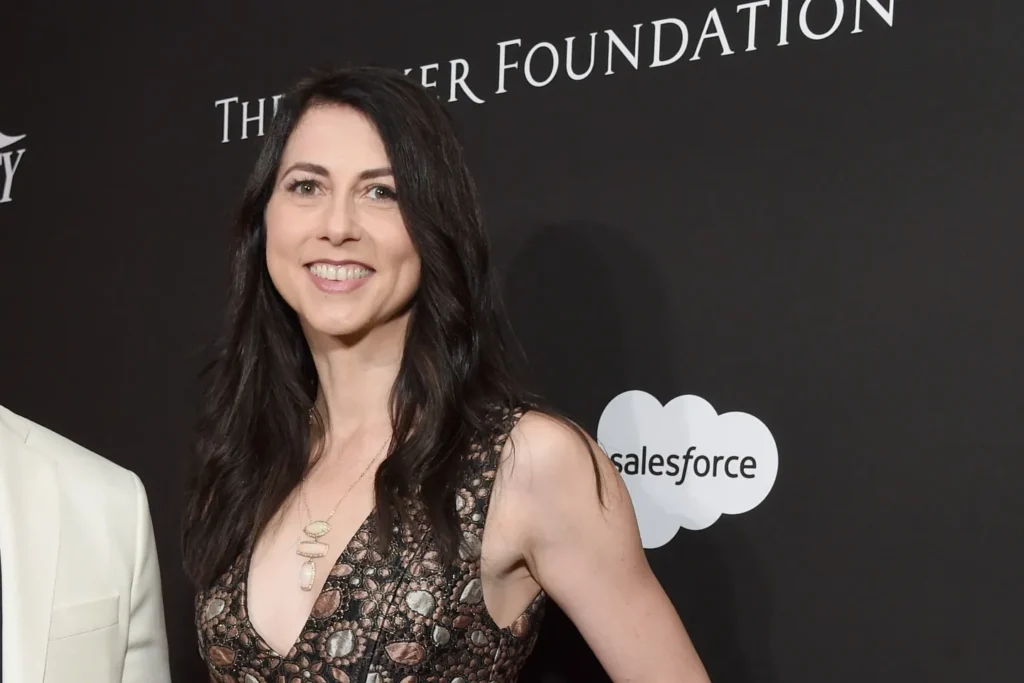
MacKenzie Scott is one of the most significant donors of the early 21st century. Since 2019, she has distributed incredible sums of money to thousands of charitable organizations, often in large open gifts that aim to accelerate programs, vary operations, and trust local leaders. Her approach, fast, large, and unencumbered, has altered beliefs about what private charity can look like and has sparked wide discussion about power, equity, and outcomes in the nonprofit world.
Below is a complete, SEO-optimized profile that traces Scott’s life and career, explains the shape and scope of Yield Giving, outlines major gifts (including the large donations post in 2023–2024 and an early-2025 UNCF gift), explains her charity philosophy, and answers common questions nonprofits and readers have about applying, impact, and liability.
Early life, education, and writing career
MacKenzie Scott (born MacKenzie Tuttle in 1970) grew up in San Francisco. She attended Hotchkiss School and majored in English at Princeton University, where she studied under the novelist Toni Morrison. After college, Scott worked briefly in finance before joining Jeff Bezos and a small team in the very early days of Amazon, where she contributed as one of the company’s first employees. She published her debut novel, The Testing of Luther Albright, which won an American Book Award in 2006, and later published a second novel, Traps.
Her early life and literary career inform how she describes herself publicly: as a reader, writer, and parent, and later, as a philanthropist driven by a desire to give away the majority of her wealth.
Amazon, the divorce settlement, and how the wealth was formed
Scott was one of Amazon’s earliest employees and retained a meaningful stake in the company through the years. Her high-profile divorce from Jeff Bezos in 2019 resulted in a settlement that included a substantial portion of Amazon stock, catapulting her into a position to become one of the wealthiest individuals in the world. That settlement provided the capital base she has since used to launch an unusually large and accelerated program of gift-making.
Why MacKenzie Scott’s philanthropy matters: scale, speed, and trust
Several elements make Scott’s giving distinct:
- Scale and speed. Scott’s gifts are often large and distributed quickly compared with traditional institutional philanthropy. She has made multiple multi-billion-dollar years of giving and hundreds of million-dollar gifts.
- Unrestricted grants. A hallmark of her grants is the lack of restrictive conditions; monies are frequently unrestricted, leaving nonprofits to decide how best to use funds. That practice counters a long trend in philanthropy where funds are tied to narrow programs or reporting regimes.
- Back-office simplification. Her team has used processes such as “open calls” to find grassroots and regional organizations that may not often be on funders’ radars. The result has been an influx of capital to small and mid-sized organizations.
Yield Giving: her philanthropic vehicle and the open call model
In late 2022, Scott launched Yield Giving, a foundation-level website that documents many of her gifts and explains her intent. Yield Giving represents a more public and systematized phase of her giving, allowing Scott to formalize practices such as public annual giving posts and open calls for applications. The Yield Giving model centers sensitivity to local autonomy, sizing gifts that can have meaningful operational impact, and making grants in fields such as early learning, affordable housing, health equity, and racial and gender equity.
The open call (2023 → 2024)
An especially notable initiative was an “open call” targeted at community-focused nonprofits with annual budgets between $1 million $5 million. Scott announced a plan to distribute unrestricted $1 million gifts to hundreds of such groups. This process led to thousands of applicants and resulted in much larger distributions than initially planned (ultimately delivering $640 million to 361 nonprofit recipients, More than doubling the initial target). The open call demonstrated how a transparent solicitation process can surface effective local organizations that often lack access to major grantmakers.
Year-by-year giving: 2020–2024 snapshot
- 2020: Scott’s giving ramped up sharply; she donated several billion dollars in a single year (notably large sums to hundreds of organizations during the COVID era). Observers noted one of the largest single-year distributions by a private individual.
- 2021: Continued substantial giving, with multiple billion-dollar totals reported across the year.
- 2023: Scott reported donating approximately $2.15 billion to hundreds of organizations that year. Reporting and the Yield Giving posts highlighted categories such as early learning and housing.
- 2024: Reporters summarized Scott’s 2024 giving as totaling roughly $2.0 billion to 199 organizations; Forbes and other outlets cataloged those gifts and noted the continuing emphasis on racial and social equity, housing, civic engagement, and health.
Combined, these multi-year distributions bring Scott’s estimated lifetime giving since 2019 to roughly $19 billion (and higher depending on reporting windows and additional 2024–early-2025 gifts). Different outlets calculate totals with slight variation, but all agree the scale is exceptionally large.
Notable gifts and sectors supported
Scott’s gifts have cut across many issue areas and organizational types. Here are some of the recurring sectors and illustrative gifts:
- Education and HBCUs. Scott has historically supported Black colleges and universities and related funds. In early 2025, she funded the United Negro College Fund (UNCF) with a major gift of $70 million intended to bolster pooled endowments and long-term financial resilience of member HBCUs, addressing a persistent funding gap compared with peer institutions.
- Housing and homelessness. Several grants have targeted affordable housing and organizations that scale housing solutions. Researchers have said her gifts have the effect of altering entire subfields (e.g., increasing investment in community land trusts and preservation).
- Early childhood learning. Scott has directed significant resources to early learning programs and advocacy, supporting interventions aimed at long-term child outcomes.
- Food security & disaster relief. Scott made multiple contributions in response to crises (including COVID-era support and assistance to communities affected by disasters), giving money to food banks and long-term recovery funds.
- Grassroots and regional organizations. The open call process intentionally surfaced small and mid-sized groups that focus on community-level change, often the groups that previously received little attention from major national funders.
Mechanisms: unrestricted grants, reporting, and transparency
Scott’s grants are notable for being largely unrestricted; that is, grantees receive funding without tight strings attached. The benefits of unrestricted capital include flexibility to cover operating costs, invest in staff, or bridge shortfalls, all of which strengthen organizational resilience. Scott’s Yield Giving reports list recipients and summarize program areas, but her approach intentionally avoids imposing detailed programmatic conditions. That strategy has been widely praised by nonprofit leaders for enabling practical acceleration of mission work.
At the same time, some observers ask for more publicly available metrics about long-term impact and evaluation. Scott and her advisors have argued that trust-based charity and capacity support are themselves key ingredients of long-term organizational impact, even if outcomes are not tied to immediate, measurable program outputs.
Impact on the nonprofit sector
Analysts and nonprofit executives have noted several broad effects of Scott’s giving:
- Liquidity and stability for nonprofits. Large unrestricted gifts have allowed organizations to hire staff, expand programs, and stabilize budgets without the administrative burden that conditional grants often impose.
- A challenge to traditional philanthropy. By giving at scale and with minimal conditions, Scott has put pressure on institutional funders and foundations to reconsider grant terms and response times. Many smaller foundations have experimented with similar trust-based funding approaches since her distributions became well known.
- Surface previously overlooked organizations. The open call and similar tactics have demonstrated that many impactful organizations are underfunded simply because they lack access to major donor networks. Scott’s process showcased an alternative pipeline for the discovery of high-impact, community-rooted groups.
Criticisms, risks, and debates
Scott’s giving model has also sparked debate. Critics raise several points:
- Concentration of power. Large gifts from private individuals inevitably raise questions about who sets priorities and whether philanthropic tastes can distort sectoral priorities. Even with unrestricted grants, critics argue that the donor’s agenda and choice of recipients reflect private preferences.
- Transparency and due diligence. While Scott’s public postings list recipients, some observers want more detail about how recipients were selected and how effectiveness is monitored over time. Proponents counter that public lists and simplicity in application processes represent a meaningful step toward transparency compared to entirely closed philanthropic practice.
- Sustainability for recipients. A sudden influx of large grants can create long-term planning challenges: organizations may scale too quickly or find it hard to maintain new programs if follow-on funding is uncertain. Unrestricted capital alleviates some risk, but sustainability planning remains necessary
How nonprofits applied
Scott partnered with organizations such as Lever for Change to manage components of open calls, vet applicants, and shortlist candidates. The open call mechanism allowed many smaller organizations to apply directly and be assessed against clear criteria. The process generated thousands of applications and ultimately led to large, multi-million dollar distributions to hundreds of groups, surpassing the initial plan in total dollars because Scott elected to expand the program’s reach.
For nonprofits, the open call demonstrated both the opportunity of a more inclusive application pathway and the reality that competition is fierce, with thousands applying for relatively few slots.
Net worth, rankings, and the Giving Pledge
Scott signed the Giving Pledge in 2019, publicly committing to give away the majority of her wealth in her lifetime or in her will. Various outlets track her Net Worth; Forbes and others publish rolling estimates that vary with market movement and gifts. Reporting in late 2024 and early 2025 placed her net worth in the tens of billions, while acknowledging the dramatic sums she has already distributed.
Practical tips for nonprofits hoping to position themselves for large gifts
While there are no guaranteed paths to receiving a major private donation, organizations can take practical steps:
- Strengthen financial reporting and governance so large donors can quickly assess organizational stability.
- Document outcomes and community ties; unrestricted gifts often go to groups that demonstrate local trust and measurable community impact.
- Engage in candid planning about how a large one-time gift would be used to build sustainable capacity.
- If open calls are announced, prepare clear, concise applications that highlight organizational track record, leadership strength, and budget clarity.

FAQs
A: Reporting estimates vary by date and methodology, but mainstream coverage places her lifetime giving since 2019 at roughly $19+ billion as of late 2024–early 2025.
A: Yield Giving is the philanthropic vehicle/site Scott uses to list gifts, explain intent, and share periodic posts about her giving. It formalized her giving practices and increased public documentation of gifts.
A: Most of Scott’s high-profile gifts have been unrestricted, meaning recipient organizations can choose how to use funds. This is a deliberate strategy to increase flexibility and resilience.
A: Scott’s team has used occasional public “open calls” to invite applications in certain budget ranges or fields. These are announced publicly. Watch Yield Giving and major philanthropy intermediaries for such announcements.
A: Yes. In early 2025, Scott made a publicly reported gift of $70 million to the United Negro College Fund (UNCF) aimed at strengthening pooled endowments for member HBCUs.
Conclusion
MacKenzie Scott’s philanthropic experiment combines urgency, scale, and trust. By giving massive sums quickly and without strict conditions, she has offered nonprofits the capital they need to scale, stabilize, and innovate. That generosity has already reshaped fields ranging from affordable housing to early childhood education, and it has provoked important conversations about power, transparency, and philanthropic responsibility.
For nonprofits, Scott’s giving demonstrates both the transformative potential of unrestricted funding and the importance of being ready in governance, outcomes, and planning to steward large gifts wisely. For the philanthropic sector, Scott’s approach has become a reference point: generous, rapid, and anchored in a belief that organizations on the ground often know best how to use resources to benefit their communities.